
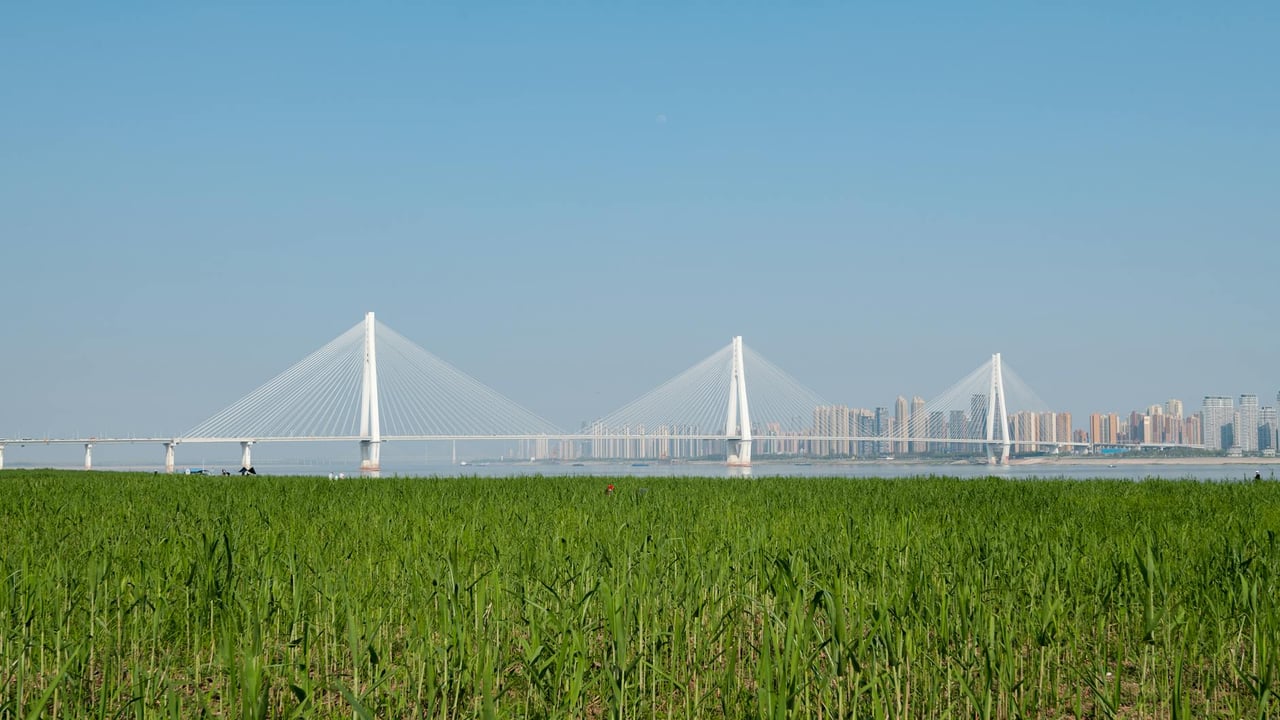

On New Year’s Day a hobbyist pilot launched a drone to film a high-speed train crossing the Nanjing Yangtze River Bridge and was brusquely ordered over a loudspeaker to retrieve the aircraft. There was no visible sentry nearby, yet the warning was prompt and specific. The incident is now a vignette in a longer account, published by state media, of how a unit of the People’s Armed Police in Nanjing has stitched together cameras, an intelligent duty platform and unmanned aircraft — its so‑called “three treasures” — to protect one of China’s most symbolically important river crossings.
The Nanjing Yangtze River Bridge, completed in the 1960s as the country’s first domestically designed double‑decker rail‑road span, is both infrastructure and icon. Guards say aging cables and a growing flow of holiday tourists have raised risks: a late‑afternoon electrical fire broke out in a blind spot on the bridge’s railway deck and was only noticed after smoke; a separate episode involved a person straying onto the track. Those near misses prompted the unit to ask bluntly what technology could do for vigilance and response.
The unit mapped the bridge in exhaustive detail, installing more than 90 camera positions and calibrating angles to eliminate blind spots. Poor visibility in foggy weather led them to deploy multiple drones as mobile eyes, and instructors were hired to train every soldier in piloting. The result, they say, is a 24‑hour monitoring network in which fixed and aerial sensors compensate for one another.
Seeing, however, was only half the problem. The unit sought software that could “read” live feeds and raise graded alerts for human operators. Working with local technicians, soldiers fed the intelligent duty platform with scenario templates drawn from years of on‑the‑job experience — lingering individuals, suspicious obstacles, drones violating no‑fly zones — and used staged exercises to hone its detection and warning algorithms.
The system has already been credited with operational successes. One evening the platform flagged a person on the railway deck; land and airborne assets coordinated on the alert and the intruder was detained. Practical innovations have complemented the tech: a seasoned corporal produced a duty checklist now displayed on the platform’s screen, while a former teacher‑soldier recorded standard public‑address commands so watchstanders can dispatch a pre‑recorded, authoritative voice at the touch of a button.
Commanders report efficiency gains: fewer personnel are needed on each watch while response times and early warning capability have improved. State media frames the effort as part of a broader campaign to “empower” frontier units with science and technology as the People’s Liberation Army and its paramilitary branches celebrate a century of history and press on with modernization.
The account offers a window on two converging trends. First, China’s security services are rapidly integrating digital surveillance, machine analysis and unmanned systems into routine domestic guarding tasks. Second, the process is not purely technological: the unit emphasizes political training, responsibility lines and local innovation, framing technological adoption as a complement to human discipline and initiative.
The bridge‑protection story also raises questions for international observers. Similar sensor‑fusion models are becoming standard in critical‑infrastructure protection worldwide, but their domestic application in China sits inside a governance context where surveillance technologies can be repurposed beyond their original remit. For now the Nanjing experiment demonstrates how modest hardware, off‑the‑shelf drones and bespoke software can reshape a paramilitary unit’s operations, lowering manpower needs while expanding the reach and immediacy of surveillance.
That combination — practical engineering, institutional backing and routine training — is why the unit describes its tools as more than kit: they are the product of what soldiers call mutual commitment between people and technology. Whether that model is scaled to other bridges, ports or urban environments will be an important indicator of how China balances infrastructure protection, public safety and the privacy and civil‑liberties concerns that accompany pervasive monitoring.