
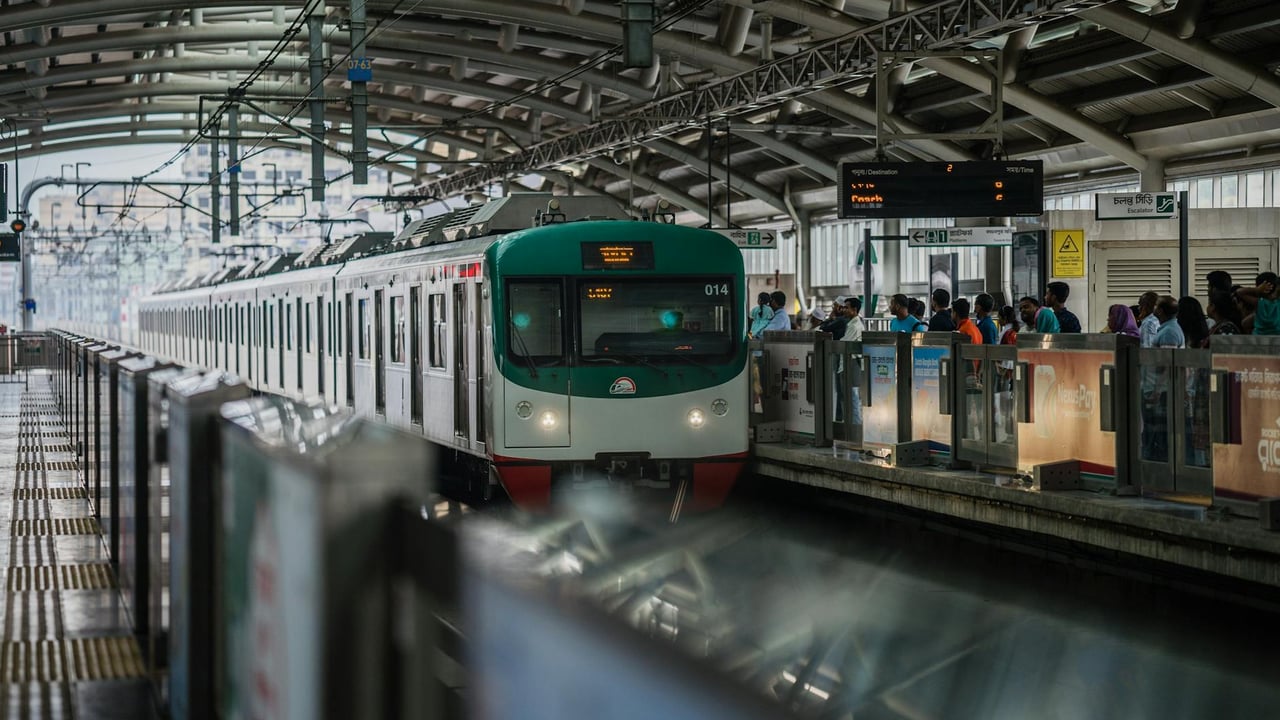

Jinan, long regarded as one of China’s most difficult cities for subway construction because of its underground spring system, has in a matter of months completed a dramatic turnaround. By the end of last year the city’s metro network reached 217.9 km, putting Jinan among the nation’s top 20 systems; an unprecedented 121.2 km of new track opened during the year, making it the biggest single-year increase in 2025.
The most conspicuous burst came in December, when four new lines were opened in quick succession. Lines 4, 6 East and 8 added about 85.1 km, and the subsequent opening of the Jiyang line contributed a further 36.1 km; the network’s total route count jumped to seven from three a month earlier, when Jinan had just 96.7 km in service.
The engineering feat is all the more striking because Jinan is not like typical tunnel cities: it sits atop more than a thousand springs and a fragile groundwater ecology that urban planners have long vowed to protect. That environmental constraint shaped Jinan’s cautious start — its first metro line only opened in 2019, later than most other sub-provincial peers — and the city has pursued a distinctive, risk-averse construction strategy ever since.
Design teams have relied on advanced four-dimensional geological visualization to map subterranean spring channels and have adopted construction methods that avoid or elevate works around sensitive aquifers. These technical safeguards, together with phased building that prioritized outer-to-inner corridors, have given planners the confidence to move from peripheral ‘test’ lines toward denser central connections.
The newly completed Line 4 is illustrative of the shift in ambition. Jinan’s long, narrow geography — hemmed by Mount Tai to the south and the Yellow River to the north — creates intense east–west commuting on corridors such as Jing10 road, which carries more than 100,000 trips a day. Line 4, dubbed the ‘underground Jing10 road,’ extends that axis and, together with the recent openings, helps forge an H-shaped core plus east–west radiations that finally make the system a network rather than a set of isolated segments.
Equally important is the northward reach achieved by the Jiyang line, which crosses the Yellow River and formally ties the northern bank into Jinan’s urban economy. That crossing advances a long-standing planning idea to move the city from a “Daming Lake era” toward a “Yellow River era,” unlocking land and investment on the river’s north side and integrating the new-and-old industrial transformation zone with the main urban area.
But engineering solutions and new track alone do not guarantee success. Ridership intensity remains low: in November the system carried about 3,900 passengers per route-kilometre per day, placing Jinan in the lower tier of Chinese metro systems and on par with nearby Qingdao. The national debate over metro losses and the National Development and Reform Commission’s tighter approval criteria for new rail have injected caution into future expansions.
Planners and officials hope that the new lines will perform not only as transport arteries but as development levers. The city is seeking to replicate TOD (transit-oriented development) examples such as Zhengdong New Area in Zhengzhou, where rail infrastructure activated a secondary centre and a new growth trajectory. Jinan’s authorities are pushing to cultivate new technology, finance and manufacturing clusters along the expanded network so that supply-side land development and demand-side ridership growth reinforce one another.
Whether that ambition pays off will hinge on follow-through: can Jinan generate and sustain the density of jobs, housing and services around stations to lift passenger numbers and reduce operational losses? If it can, the metro will have performed a classic urbanist trick — knitting a constrained, single-centre city into a multi-nodal metropolis with greater economic reach. If it cannot, the city risks an expensive infrastructure legacy that outpaces real travel demand and fiscal capacity.