
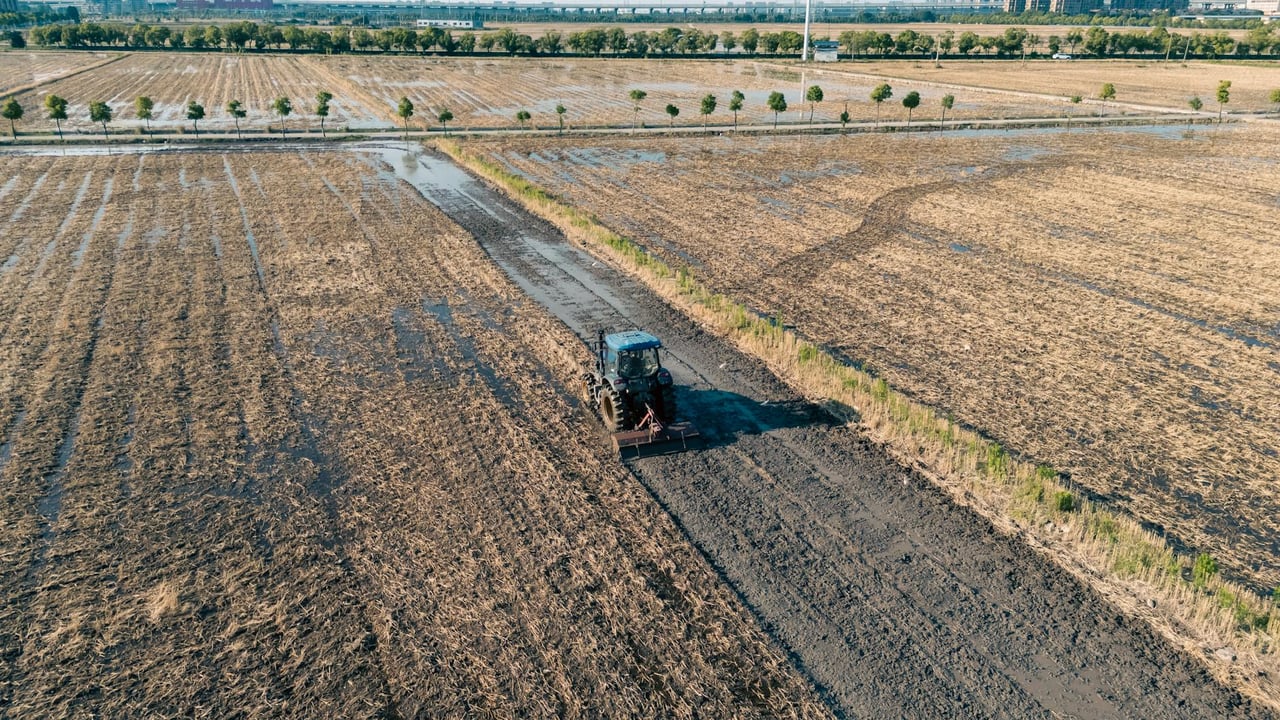

Beijing on Friday published a set of figures that portray China’s countryside as both resilient and repositioned. Grain output in 2025 reached a fresh high of 14,298 hundred-million jin — roughly 715 million tonnes — while production of pork, beef, mutton and poultry climbed to about 100.7 million tonnes, up 4.2% year-on-year. Rural per‑capita disposable income rose to 24,456 yuan, a real increase of 6%, and more than 32 million people from formerly poor households found waged work last year.
Officials used the data to frame a transition in rural policy. With the five‑year “transition period” that followed the end of mass poverty alleviation now concluded, the Ministry of Agriculture and Rural Affairs says China will move into a new phase of “normalised” support: coordinated, development‑oriented aid integrated into the broader rural revitalisation strategy rather than large, temporary rescue programmes. That shift accompanies a renewed emphasis on building agricultural productivity, supply chains and social safety nets to prevent large‑scale relapse into poverty.
Practical levers are already on display. Beijing intends to accelerate agricultural modernisation through a suite of measures: a new round of a “thousand‑hundred‑million‑jin” (千亿斤) grain‑capacity push, more high‑standard farmland, promotion of higher‑yield varieties, and efforts to improve storage, cold chains and downstream processing. Policymakers want to extend value chains — from initial processing to deep processing and byproduct use — and to cultivate “chain‑leading” enterprises to raise farmgate returns.
Land tenure stability is central to those plans. The government has rolled out province‑level pilots to extend land contracts by 30 years after their current expiry, covering seven whole provinces plus hundreds of counties and townships and affecting some 25 million households so far. Officials say the measure will give farmers the “peace of mind” to invest in productivity and mid‑to long‑term improvements on their plots, a key prerequisite for mechanisation, higher‑value cropping and green agriculture.
The ministry also stresses livelihood protection. As the special poverty‑reduction window closes, Beijing will fold assistance into routine social protection and development‑oriented programmes — a calibration intended to preserve gains while cutting the risk of dependencies. Authorities pledge to keep employment support and industry assistance targeted at the most vulnerable, while mobilising more market actors — agribusinesses, cooperatives and service providers — to raise incomes sustainably.
For international audiences, the figures matter for several reasons. China's rising grain output and growing meat supply temper concerns about global food shortages and volatile commodity markets; they also reflect Beijing’s continuing priority of food self‑sufficiency even as the domestic demand for better quality and diversified foods increases. Domestically, the balance between production growth and rural income growth will shape political stability in the countryside, migration patterns to the cities, and the pace at which China can modernise agriculture without exacerbating environmental pressures.
The plans, however, will not be easy to execute. China faces a constrained land base, mounting ecological limits, an ageing rural labour force and the inefficiencies of very small holdings. Creating more cold chains, catalysing large processors, or persuading millions of smallholders to change cropping systems requires substantial public investment, credible local implementation and private capital — all while ensuring that expanded industrial processing benefits farmers rather than merely processors.
In short, Beijing is attempting to pivot from a poverty‑relief era to a longer‑term model: one that combines tightened food security, farm productivity enhancement, chain integration and social protection. Success will depend on whether tenure security, technological upgrades and market development can translate into sustained and equitable income gains for rural households across China’s diverse geographies.