
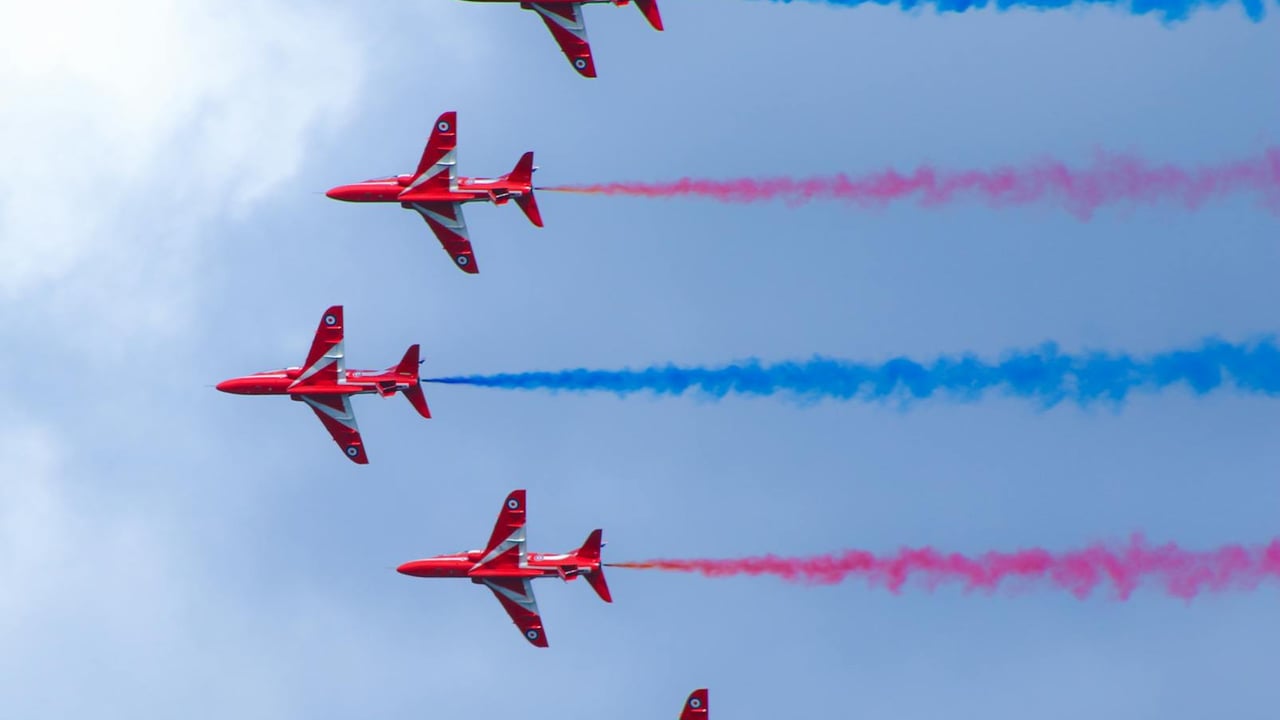

A six‑ship formation of China’s Bayi (August 1) aerobatic team completed a validation flight over Singapore’s Changi Airport on the morning of February 1, rehearsing for the tenth Singapore Airshow scheduled for February 3–8. The J‑10 display jets — freshly re‑equipped in the upgraded J‑10C variant and bearing the Chinese national flag and the Bayi insignia — flew a rapid two‑wave takeoff into a 600‑metre cloud base before assembling over nearby sea airspace to perform tight formations and smoke‑trail passes.
The routine included a six‑ship ultra‑tight pass followed by five‑, four‑, two‑ and solo‑ship sequences, with the team trailing red, yellow and white smoke intended to reference the colours associated with China and Singapore. Team leader Li Bin framed the appearance as a return after six years and the first Singapore outing for the unit in its new aircraft configuration; organisers say the rehearsal is the second sortie since the team arrived and precedes three scheduled public displays at Changi.
The exercise was conducted alongside test flights by aircraft from Singapore, Malaysia, Australia, Indonesia and India, and organisers highlighted the smooth coordination of airspace and traffic management that underpinned the multinational validation sorties. For the Bayi team it also served as a comprehensive dress rehearsal: an operational check of new equipment, refined formation procedures and final timing ahead of demonstrations to an international audience.
At face value the flight is a conventional airshow appearance — a public demonstration of skill and theatre aimed at delighting spectators. But several layers of signalling sit beneath the aerobatics. The deployment marks a visible export of Chinese military soft power and a demonstration of the PLA Air Force’s modernisation, now incorporating the J‑10C’s improved avionics and sensors into public international displays.
Participation in Singapore follows the Bayi team’s last appearance at the city‑state’s airshow in 2020 and underlines a post‑pandemic return to routine foreign military engagement. For Beijing, such appearances serve multiple aims: showcasing technological progress, normalising military‑to‑military contact, and buttressing diplomatic ties through carefully staged symbolism — in this case the shared stage with South‑east Asian and wider regional partners.
For regional observers the implications are mixed. Neighbours and partners will note the display of more modern Chinese combat aircraft and their interoperable operation within closely managed international airspace. Yet the event is also a form of reassurance: the choreography, smoke colours and bilateral framing emphasise openness and people‑to‑people exchange more than coercive intent.
The Singapore Airshow will give the Bayi team three opportunities to present its new repertoire of manoeuvres over foreign soil. Beyond spectacle, the performances feed into China's broader defence diplomacy and defence industrial narrative: the J‑10C’s public debut overseas will be watched by potential customers, journalists and defence planners alike, adding a commercial and strategic subtext to what appears, on the surface, as an aerobatic display.