
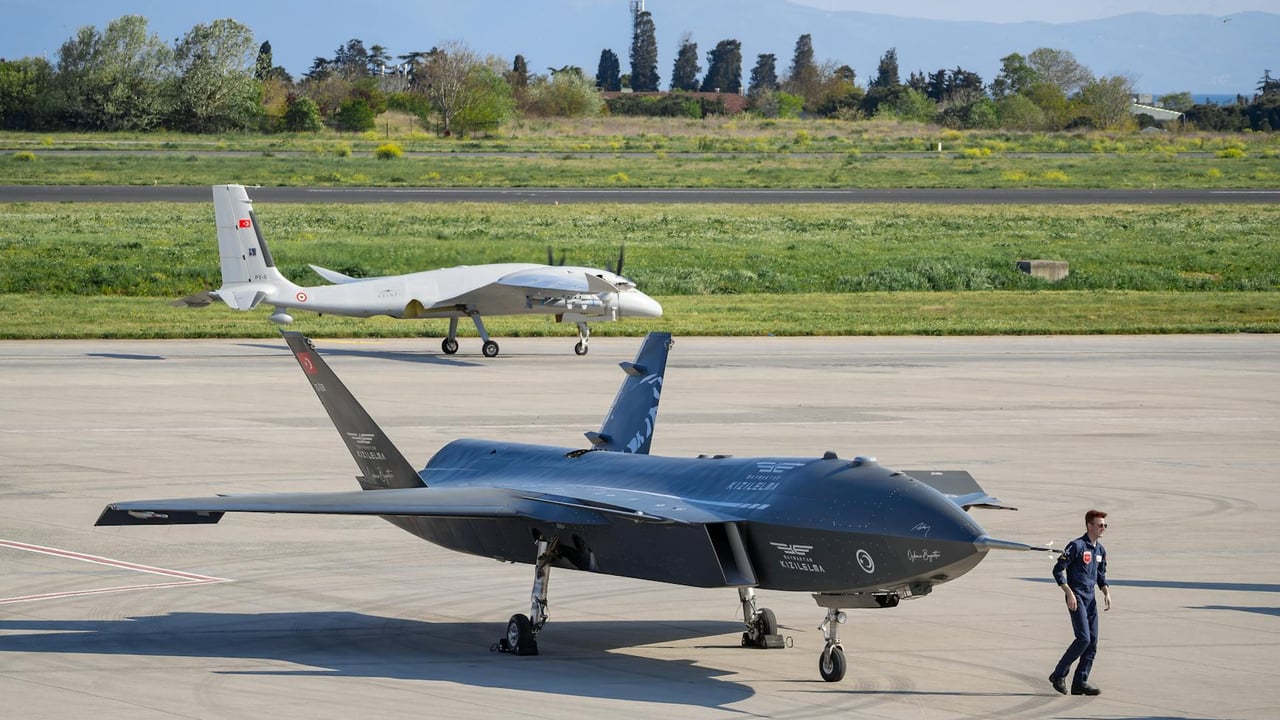

Iran has announced the induction of 1,000 new military drones and publicly displayed six different models, a move framed by Tehran as preparation for a potential American strike. State media images show a mix of designs — flying wings for reduced radar signature, jet-powered types intended to penetrate defences, and long‑wing variants optimized for endurance — and commanders say the fleet will cover strike, reconnaissance and electronic warfare roles against land, sea and air targets.
The military presentation, accompanied by remarks from Army commander Major General Hatami, casts the programme as both a technological response to changing battlefield conditions and a lesson drawn from last year’s brief Iran–Israel exchanges. Iran’s emphasis on quantity and diversity signals a shift from bespoke prototypes to massed capability intended to overwhelm layered air defences and complicate targeting calculus.
Washington has already signalled unease. US officials point to roughly 40,000 personnel in dozens of bases across the region who are exposed, in their view, to thousands of drones and ballistic missiles. Central Command has staged dispersal exercises and other preparedness drills that amount to rehearsals for how to shelter forces and equipment if high‑tempo attacks arrive.
The announcement also stiffens Tehran’s network of proxies. Yemen’s Houthi movement has hinted at renewed attacks on Red Sea shipping, Iraqi militias warned that strikes on Iran could spark all‑out war, and Israeli and Western analysts say Hezbollah could be readied to intervene if ordered. A recent Israeli defence‑think‑tank assessment suggested Hezbollah has rebuilt significant capabilities, including an expanded rocket inventory and a reported drone fleet of its own.
Gulf capitals are caught between alliance obligations and commercial caution. Saudi Arabia and the UAE have publicly ruled out allowing their airspace or territory to be used for strikes on Iran and have urged diplomacy, reflecting a pragmatic desire to avoid disruptions to oil and shipping that would hit their economies. Memories of the 2019 attacks on Saudi energy infrastructure still inform their reluctance to become launchpads for a wider conflict.
Strategically, Tehran’s massing of unmanned systems represents an asymmetric doctrine that seeks attrition through saturation. A thousand drones, deployed in waves or through proxy networks, could create windows of temporary superiority and force expensive, time‑consuming responses; at sea, commanders worry that coordinated attacks combining drones and fast attack craft or torpedoes could overwhelm shipboard defences.
That said, state announcements and parade imagery do not automatically translate into operational effect. Questions remain about production rates, logistics, secure command and control, and the resilience of these systems against jamming, cyber intrusion and kinetic interception. Western and regional militaries retain formidable sensors and shooters; the outcome of any escalation would depend on the scale, coordination and sustainment of Iranian employment and of allied countermeasures.
The near term will be defined by three variables: Tehran’s willingness to transfer platforms to proxies for deniable operations, US and allied adjustments to force posture and maritime security, and Gulf states’ diplomatic choices. Each carries the risk of miscalculation that could transform a calibrated deterrent into a region‑wide conflagration.