
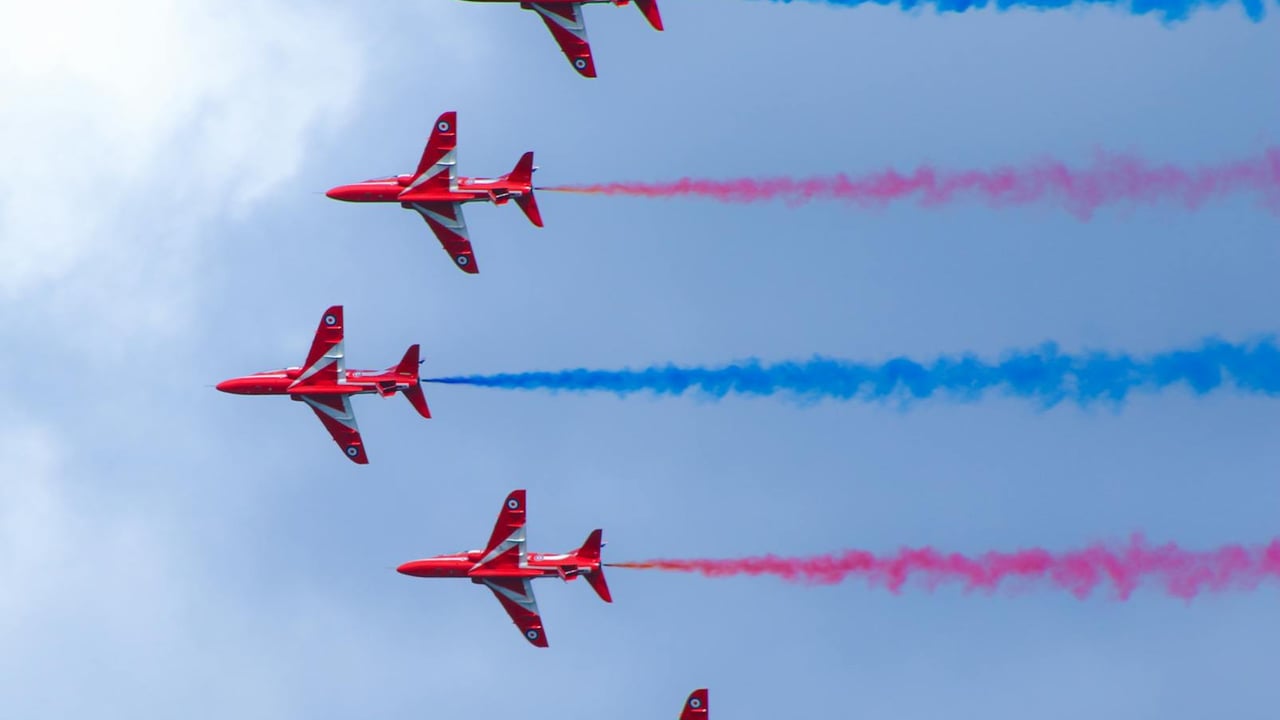

China’s People’s Liberation Army Air Force (PLAAF) aerobatic team, the August 1 (Bayi) squadron, concluded its participation in the 10th Singapore Airshow on 7 February with a final precision display over Changi. Flying J-10 demonstration aircraft painted with the Chinese flag and the unit’s insignia, the six‑ship formation performed dense low passes, rolls and synchronized “flower” dispersals that drew repeated cheers and flag‑waving from an international crowd.
Before the flight, pilots engaged directly with spectators, posing for photos and handing out signed posters while performers and parts of the audience joined in singing the patriotic song "My Motherland and I." The team timed its public greetings with the lunar new year, offering cross‑border spring festival wishes that combined cultural diplomacy with the spectacle of military aviation.
The Singapore Airshow is Asia’s premier aerospace trade fair and a showcase for both civilian and military aviation. Bayi’s multiple public sorties — including adaptation flights, certification runs and the scheduled airshow performances — served not only as a demonstration of piloting skill but also as a platform for Beijing to project a benign, professional image of the PLAAF to an international audience and to Singapore specifically.
Technically, the display highlighted the J-10’s agility in compact formations and the pilots’ discipline in executing complex, tightly timed manoeuvres such as six‑aircraft rolls and five‑ship peels. For aviation observers, these routines are less about battlefield tactics than about signalling operational competence, training standards and the ability to operate reliably in crowded, multinational airspace.
Politically, the appearance in Singapore is significant because the city‑state maintains close ties with both Beijing and Western powers and routinely hosts multinational defence and industry events. By participating and interacting warmly with spectators, Bayi reinforced military‑to‑military contact, underlined bilateral goodwill and contributed to a narrative of China as a responsible regional actor at a moment when its military modernization remains a source of attention across Asia.
That said, air displays are inherently dual‑use communications: they reassure by showcasing professionalism and safety, but they also normalise the visibility of advanced assets abroad. For regional governments and defence planners, the spectacle will be catalogued alongside other indicators of Chinese airpower growth — not as a provocation, but as another data point in assessments of training tempo, interoperability and the PLA’s public diplomacy strategy.