
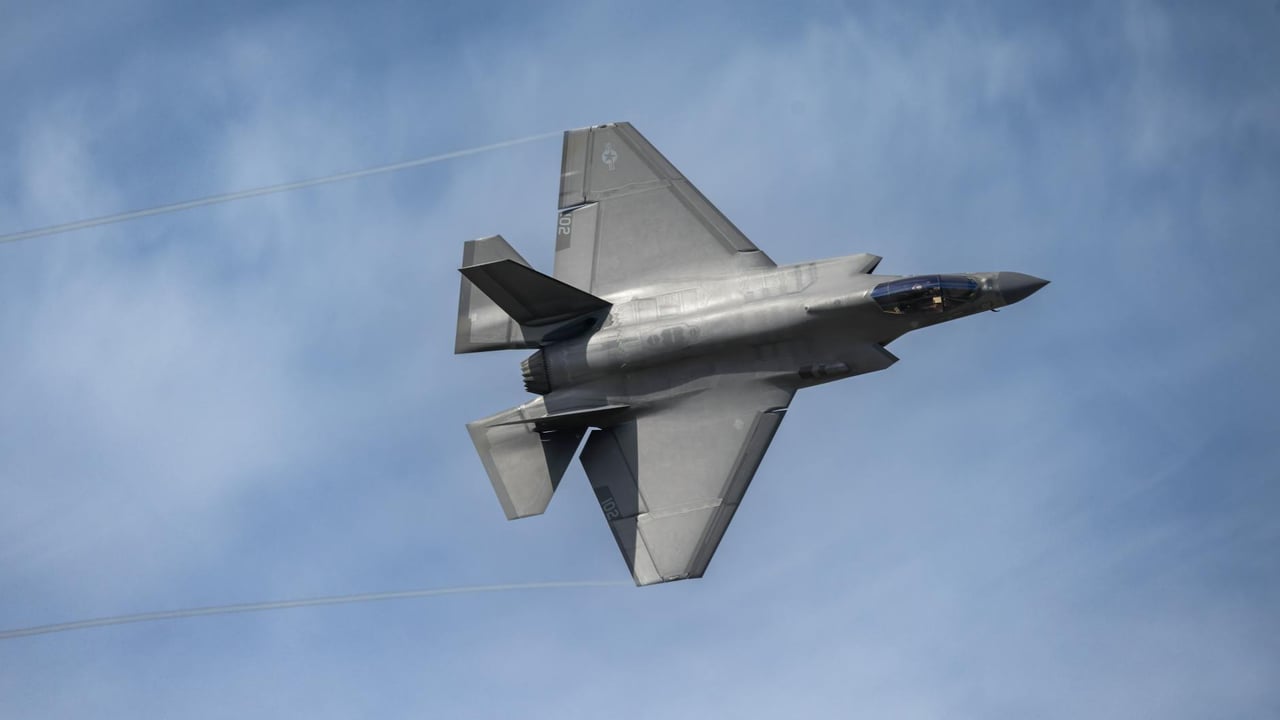

The United States has begun receiving F‑35A aircraft that, on delivery, lack the new AN/APG‑85 active electronically scanned array (AESA) radar intended for the Block 4 upgrade, exposing fresh complications in a programme long plagued by concurrency and cost overruns. Since June 2025 some airframes delivered to the US Air Force have arrived without radars because development of the APG‑85 has run behind schedule and over budget. The Joint Program Office has neither confirmed nor denied the scale of the shortfall, saying only that APG‑85 installations will begin with the 17th production lot and continue into 2026, and that detailed information is being withheld for program security reasons.
Publicly available evidence and congressional comment provide a clearer picture. The 17th production lot has entered delivery, and an exchange with Representative Rob Wittman made clear that fitting APG‑85 requires physical modification to the forward fuselage — notably different radar mounts and structural frames — so the new and legacy APG‑81 installations are not compatible without significant change. Industry and media sources say there is no off‑the‑shelf “universal” mounting solution in place; developing one would take roughly two years, and Lockheed Martin has reportedly proposed a forward fuselage redesign to allow flexibility between radar types, with the earliest adoption pushed to lot 20 in 2027–28.
Operational workarounds are imperfect. Some radar‑less F‑35s have been fitted with ballast in the nose to preserve trim and are limited to flights accompanied by radar‑equipped jets for training. In a combat setting, the absence of an on‑board radar sharply curtails independent operations: tasking would be constrained to low‑threat environments or force commanders would have to accept greater risk by relying on wingmen or allied platforms to supply radar picture via datalinks. That reliance increases electromagnetic emissions and thus detectability, and it also deprives the aircraft of radar functions central to advanced electronic attack and high‑power sensing.
Proponents point to the F‑35’s sensor fusion and data links — including MADL, distributed aperture systems (DAS), the electro‑optical targeting system (EOTS) and Link 16 — as mitigating factors that preserve situational awareness even without an APG‑85. Those tools can share and aggregate targeting data across a formation, but they do not replace an AESA’s ability to perform long‑range search, high‑power electronic attack, and certain modes of synthetic aperture sensing. The practical upshot, acknowledged even by sympathetic outlets, is a markedly reduced capability in high‑threat, contested environments.
The radar delay is one symptom of broader Block 4 troubles. A September 2025 Government Accountability Office report found the Block 4 upgrade programme some $6 billion over budget and at least five years behind schedule. Beyond the APG‑85, the programme faces hurdles with a new electronic warfare suite, sensor replacements for DAS and EOTS, greater onboard computing power, and enhanced cooling and power distribution. Separately, the F135 engine’s limited electrical generation and thermal margins remain an unresolved constraint, complicating the timely integration of power‑hungry subsystems.
For international customers the immediate impact is muted: partner nations continue to receive F‑35s fitted with the existing APG‑81 radar. But the episode carries reputational and strategic consequences. Allies and potential buyers watch how the US manages complex upgrades and whether recurring concurrency problems force retrofits, drive up sustainment costs, or defer capability improvements. Militarily, while the F‑35 fleet will not become useless, the temporary delivery of aircraft lacking core sensors reduces fleet flexibility, forces changes in training and tactics, and could be exploited by adversaries who track U.S. readiness gaps.
This latest setback reinforces a recurring lesson in advanced defence procurement: beginning serial production before a design is mature shifts costs and complexity into sustainment and retrofit phases. That path can keep production lines busy in the near term but creates long tails of expensive modifications and operational compromises later. For policymakers and planners, the choice now is whether to accept incremental fixes and schedule slippages, to invest heavily in redesign and accelerated manufacturing changes, or to temper expectations about the timeline and scope of Block 4’s promised capabilities.