
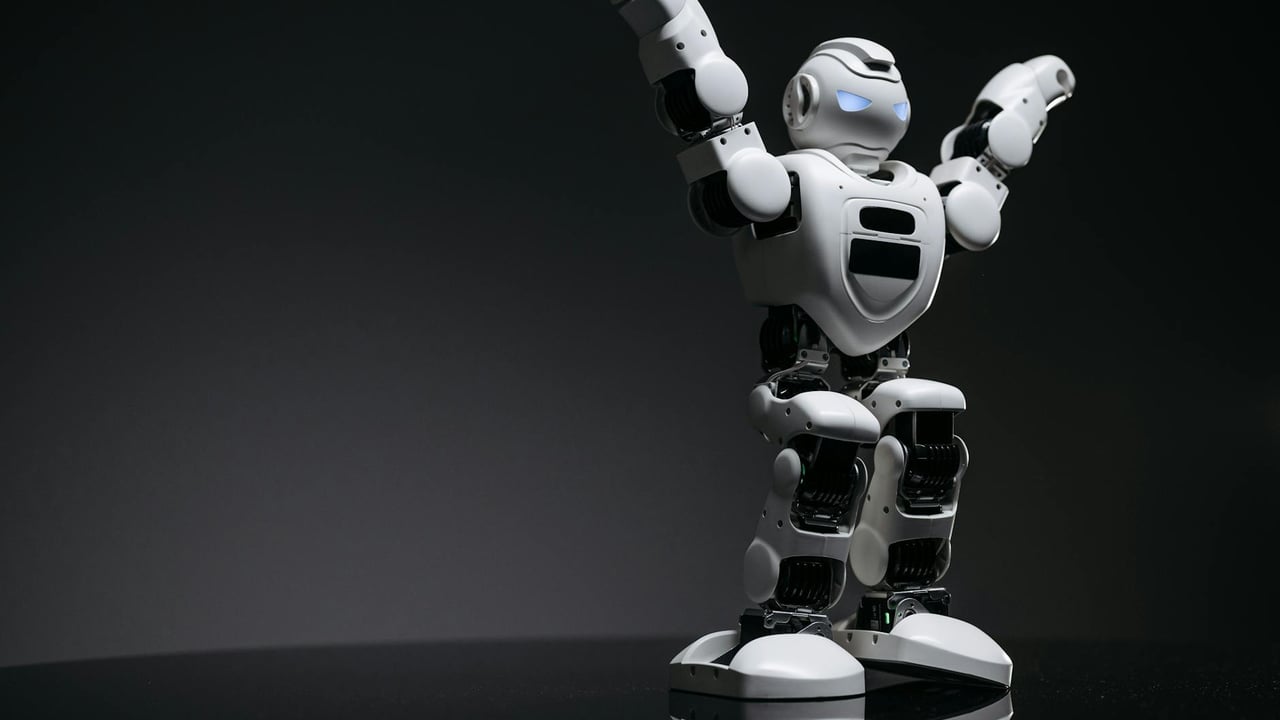

China’s 2026 CCTV Spring Festival Gala staged something novel for a national variety show: humanoid robots not as curiosities but as polished performers. Four domestic companies — Yushu Robotics, Magic Atom, Galaxy General and Songyan Dynamics — presented routines that ranged from acrobatic flips and coordinated dance to domestic chores and scripted comic interaction with stars, turning the annual, family‑viewed broadcast into an industrial proving ground.
The acts were engineered to play for more than applause. Yushu’s machines executed vaulted jumps, front and back flips and weaponised martial‑arts choreography with a custom launcher and millions of simulator runs behind them. Magic Atom fielded eight machines that kept tight multi‑robot synchrony to the beat of a pop song. Songyan adapted a bionic humanoid into a “robot grandson” that shared a comic skit with veteran actress Cai Ming, improving facial micro‑expression rates from 10Hz to 60Hz and adding neck degrees of freedom so the doppelgänger read as affectionate rather than machine‑like. Galaxy General chose narrative rather than spectacle, embedding its Galbot G1 in a micro‑film where it cleaned broken dishes, fetched goods from shelves and clipped a sausage — demonstrations intended to sell competence, not wonder.
Beyond entertainment value, the performances advertised three engineering bets. First, refined motion control: large dynamic movements and stable group choreography require precise closed‑loop sensing, joint actuation and real‑time decision loops, which Yushu and Magic Atom publicly stressed. Second, affective embodiment: Songyan emphasised micro‑expression control and physical likeness to reduce the “cold machine” reflex, an attempt to make companionship a plausible near‑term consumer application. Third, embodied intelligence: Galaxy General foregrounded end‑to‑end “embodied large models” — integrated perception and decision networks for grasping, navigation and task generalisation — positioning software rather than bespoke hardware as the next battleground.
The commercial subtext was explicit. Public success on the Spring Gala is now a marketing and capital milestone. The exposure helps firms seeking IPOs, venture funding and anchor customers; Galaxy General’s $3 billion valuation and the other companies’ moves toward stock market readiness were noted by commentators. Investors and executives say the sector will bifurcate: a handful of well‑funded leaders extend their advantage in data, supply chains and engineering teams while many smaller competitors face survival pressure.
For Chinese policy and industry watchers the show has symbolic heft. The Gala is watched by hundreds of millions; staging robots on such a zero‑error platform is a public signal that humanoid robotics has moved from laboratory demos to engineered, repeatable spectacle. That visibility helps normalise robotics as household technology and frames the narrative of “technology for good” — care, companionship and service — which aligns with state messaging on technological modernisation and social utility.
Yet the spectacle masks technical and economic constraints. Many of the featured feats still rely on trade‑offs: launchers to achieve extreme jumps, limited thermal headroom requiring vented or lightweight costumes, and staged, highly constrained environments that are orders of magnitude simpler than chaotic homes or factories. True utility will demand longer battery life, robust perception in unstructured spaces, safe human‑robot interaction standards and economical mass manufacturing that brings prices from tens of thousands of yuan down toward mass‑market thresholds.
The Spring Gala also sharpens a strategic debate inside robotics: will the next wave of differentiation come from better actuators and motion stacks, or from “brains” — large, embodied AI models that generalise across tasks and contexts? Investors quoted after the broadcast forecast a transition from a hardware arms race to a contest over data, model scale and real‑world task diversity. Whoever secures the richer embodied datasets and refines transferable control policies will gain the strategic upper hand when the sector seeks scale in retail, logistics, eldercare and industry.
In short, the 2026 Gala was less a one‑off entertainment novelty than a staged milestone: a national‑scale stress test of stability, polish and narrative framing. It sent a clear message to customers, regulators and global competitors that Chinese humanoid robotics has reached a new degree of industrial maturity — and that the race now centres on the architectures that let robots think and adapt, not just move.