
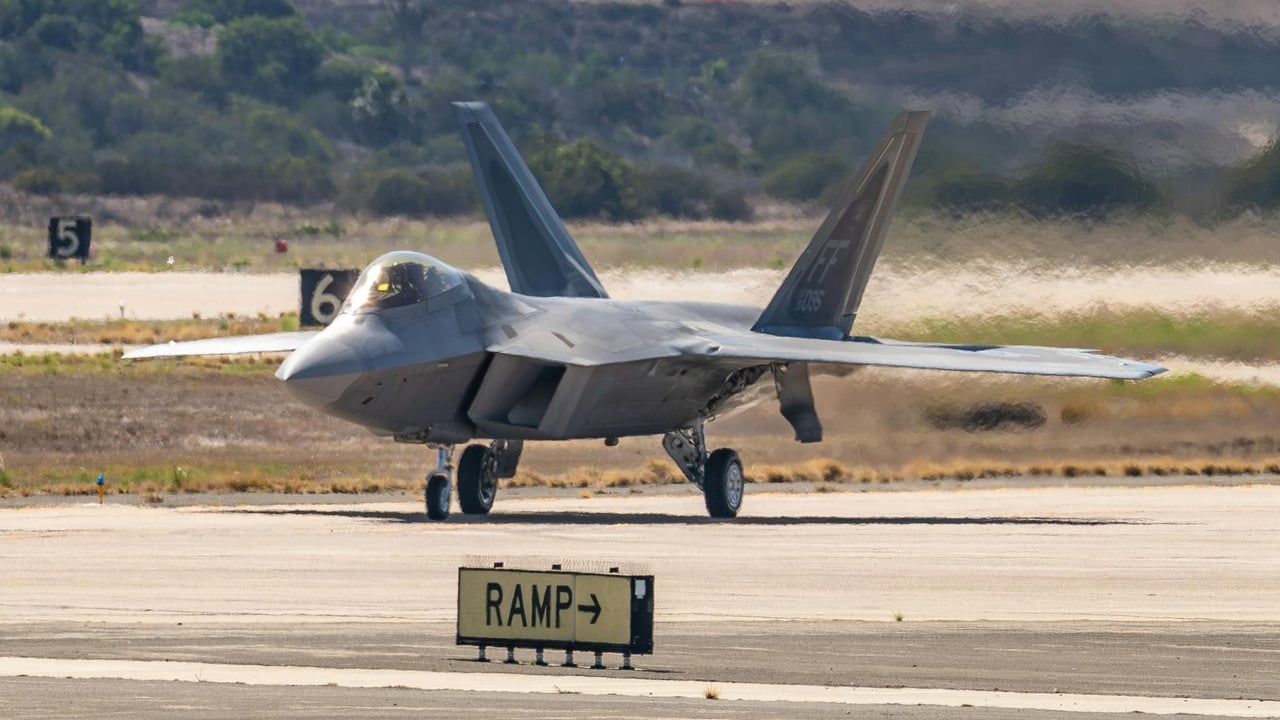

Satellite imagery dated February 26 shows 11 U.S. F-22 “Raptor” stealth fighters parked at Ovda Airbase in southern Israel, a forward facility near the Red Sea. The deployment, part of a fresh wave of American force movements into the region, is the most conspicuous demonstration yet of Washington’s intent to bolster its airpower foothold close to potential flashpoints.
The F-22 is a fifth-generation, multi-role fighter built around stealth, advanced sensors and the ability to sustain supersonic cruise without afterburners. The U.S. Air Force describes it as superior to any currently known or foreseeable rival, and the platform has never been exported because it carries classified technologies. At roughly $143 million per airframe, the 11 jets represent military hardware worth more than $1.5 billion on the tarmac.
Placed at Ovda, the Raptors gain rapid access to the southern corridors of Israeli-controlled airspace and the broader eastern Mediterranean and Red Sea regions. For Washington and Tel Aviv the tactical advantages are clear: stealthy air superiority, improved situational awareness and the capacity to penetrate contested airspace in the event of strikes or high-end engagements with sophisticated air defenses.
But the deployment is not just about hardware. Forward-basing a limited number of F-22s conveys diplomatic and strategic messages to Tehran and to Iranian-backed proxies across the Levant. It reassures an Israeli government seeking both deterrence and escalation insurance while signaling to other regional actors that the United States is ready to project advanced capabilities at short notice.
Operationally, the Raptors bring critical attributes—survivability against modern air defenses and sensor fusion that can tie into wider strike packages—but they are not a panacea. The aircraft’s small fleet size, logistics demands and restricted weapons bay limit how much they can contribute in sustained strike campaigns compared with larger, more numerous strike platforms. Their primary immediate value is deterrent and command-and-control leverage rather than wholesale substitution for conventional strike wings.
The presence of F-22s in Israel raises questions about escalation management and calculations by adversaries. While intended to lower the probability of kinetic surprises by raising the cost of aggression, such high-profile deployments can also harden adversary resolve or prompt countermoves, from asymmetric attacks to stepped-up air defenses. How Tehran and its proxies respond will be an important gauge of whether the deployment stabilizes or complicates the security environment.
As Washington rotates advanced assets into the Middle East, the broader test will be whether forward presence translates into de-escalatory power or into a new layer of militarized deterrence that makes crises harder to resolve. For now, the Raptors at Ovda are a clear demonstration of high-end backing for Israel and a reminder that U.S. military posture remains the central balancing factor in the region’s evolving security equation.