
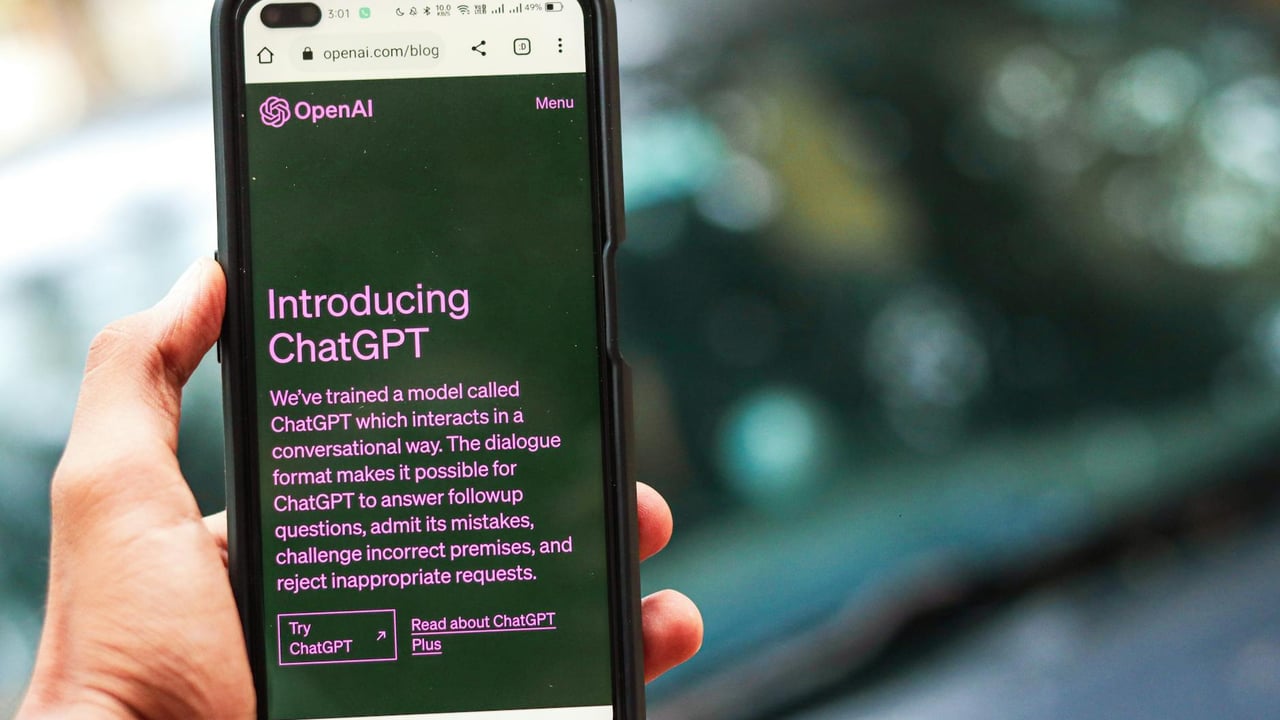

OpenAI has released GPT‑5.4 and a higher‑capacity variant, GPT‑5.4 Pro, rolling the models into ChatGPT, the API and its Codex product. The headline technical advance is native support for context windows up to one million tokens on Codex and the API, alongside a new "Thinking" mode in ChatGPT that preserves context for longer deliberations and lets users interrupt and redirect the model mid‑response.
The practical effect is to move foundation models from brief Q&A and short prompts toward sustained, multi‑stage work. With a million‑token window — enough to encompass entire large codebases, long legal briefs, or extensive research dossiers — GPT‑5.4 is positioned to act as an agent across protracted, tool‑intensive workflows: chaining calls to external tools, searching expanded plugin ecosystems, and generating or revising substantial bodies of text and code without losing earlier context.
OpenAI also describes "native computer usage": the model can more directly script, orchestrate and operate software tools. Combined with Codex and API support for extended contexts, that capability promises more capable automated assistants for software engineering, data analysis, and document processing, where maintaining state across many steps and files is essential.
The feature set has immediate commercial appeal. Enterprises and developers can build agents that reason over months of documents or millions of lines of code, reducing the friction of frequent state re‑feeding or bespoke retrieval systems. For OpenAI, this opens another vector for monetisation through premium tiers, specialised Pro offerings and heavier API usage by companies automating complex workflows.
But the advance also sharpens policy and safety questions. Larger context windows increase risks of memorising and exfiltrating sensitive information, and give models more opportunity to discover and exploit external tools. Regulators, enterprises and platform operators will need stronger access controls, sandboxing and audit trails to manage data governance and misuse risks.
Strategically, GPT‑5.4 intensifies the platform race among major AI players. Western incumbents are pushing capability forward while Chinese cloud and AI firms — which have been rapidly scaling their own large models — will judge whether to pursue matching context sizes, tighter tool integrations, or different trade‑offs on latency, cost and domestic regulation. The result is likely faster productisation of agentic AI across sectors, but also renewed scrutiny from governments worried about economic concentration and security vulnerabilities.
Technically, a million‑token window is not an endgame: it raises immediate engineering demands on memory, latency and cost. Deployments will require more efficient retrieval systems, compression and hierarchical reasoning to remain responsive and economical. In short, GPT‑5.4 marks a pragmatic turning point — not a leap to general intelligence, but a powerful upgrade for tasks that require continuity, scale and tool use.