
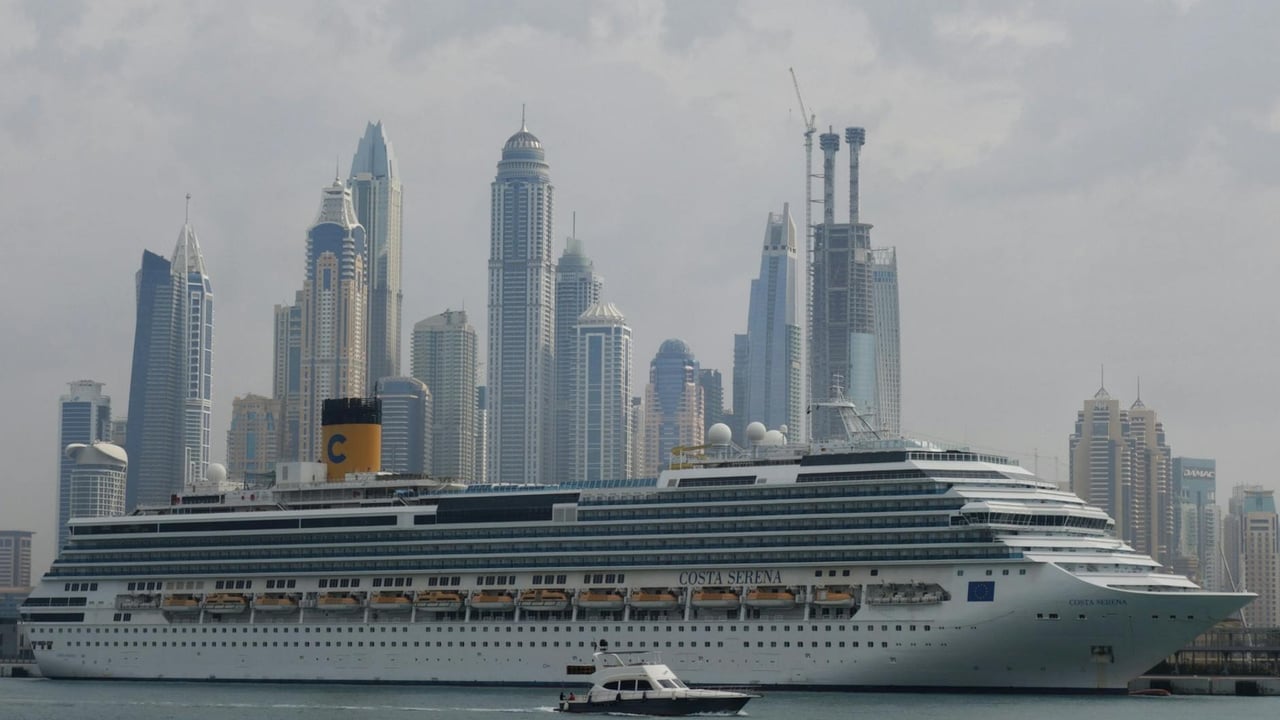

When war crept closer to the Persian Gulf in late February 2026, a handful of cruise ships that had promised leisurely stops along glittering Middle Eastern ports became makeshift shelters. One vessel widely mentioned in Chinese reporting, referred to as MSC "Shennü" and carrying roughly 200 Chinese passengers among more than 5,000 on board, was due to leave Dubai’s Rashid Port on February 28 but remained moored as regional airspace and ports were reshaped by missile and drone exchanges.
For the tourists onboard the ship, the disruption translated into a strange inversion: a floating resort that by design isolates travellers from the world became their only refuge from an unfolding conflict. Passengers described routine life continuing—meals, shows, pool hours and dress-code nights—but with a new, invasive pastime: following rolling security alerts and watching news about strikes on hotels, airports and even the cityscape they had planned to explore.
The experience was personal and patchwork. Retiree Wang Qing, who had taken five MSC cruises before and viewed the ship as a comfortable, familiar space, said she felt more relieved than panicked about being kept at sea. Others, such as a young woman named Linlin travelling with elderly parents, fought exhaustion, mounting costs and uncertainty as they sought refunds and permission to disembark.
Not all passengers stayed on board by choice. In early March several cruise companies began organising staggered evacuations by nationality and the vessel operators later ordered full disembarkation with temporary local accommodation offered for a limited period. Many Chinese passengers who left Dubai sought secondary overland or air routes via Oman, enduring long road transfers and expensive, last-minute tickets to return home.
The maritime disruption was not limited to a single ship. The UN’s International Maritime Organization reported on March 5 that about 20,000 seafarers and 15,000 cruise passengers were stranded across the Gulf, a sign that the conflict’s logistics impact extended beyond airports to the shipping lanes and port operations that sustain tourism and trade. The UAE reported significant intercepts and some domestic damage from missiles and drones, amplifying fears that debris falling into civilian areas could be the more diffuse danger.
For Chinese travellers the incident highlighted several friction points in modern mass tourism: the fragility of long-haul, multi-stop cruise itineraries, patchy real‑time consumer protections, and the uneven reach of consular assistance in complex transit hubs. Passengers banded together in ad hoc WeChat groups to exchange flight updates and provide mutual reassurance; travel agencies and local ground handlers played the decisive role in arranging onward travel but often at a steep personal cost for the travellers.
The economic fallout was immediate and tangible. Some passengers received refunds from MSC but still faced non-refundable domestic tickets and hotel losses; others spent tens of thousands of RMB more than originally budgeted on rerouting through Oman or Indonesia. Local purchases, such as medicines sourced at four times domestic prices, and last‑minute protective logistics compounded the financial sting of an otherwise routine vacation.
Beyond headline anecdotes, the episode has broader implications for the travel industry and regional tourism. Dubai, which recorded nearly 19.6 million international overnight visitors in 2025 and hosted roughly 860,000 Chinese tourists that year, depends on the perception of safety to sustain its growth. A short-lived flare-up that tangibly disrupts cruise schedules and air links risks amplifying reputational damage, spurring insurers and tour operators to reassess routes that pass through the Gulf and prompting cruise lines to alter itineraries or boost contingency planning.
The crisis also speaks to geopolitics meeting consumer mobility. Modern leisure is threaded through contested spaces: cruise lines, airlines and individual tourists now navigate a landscape where commercial schedules intersect with military thresholds. How companies, insurers and states adapt—through tougher routing, clearer passenger protections, faster consular coordination and higher risk premiums—will shape whether such incidents remain episodic or become a new normal for travel in politically sensitive regions.