
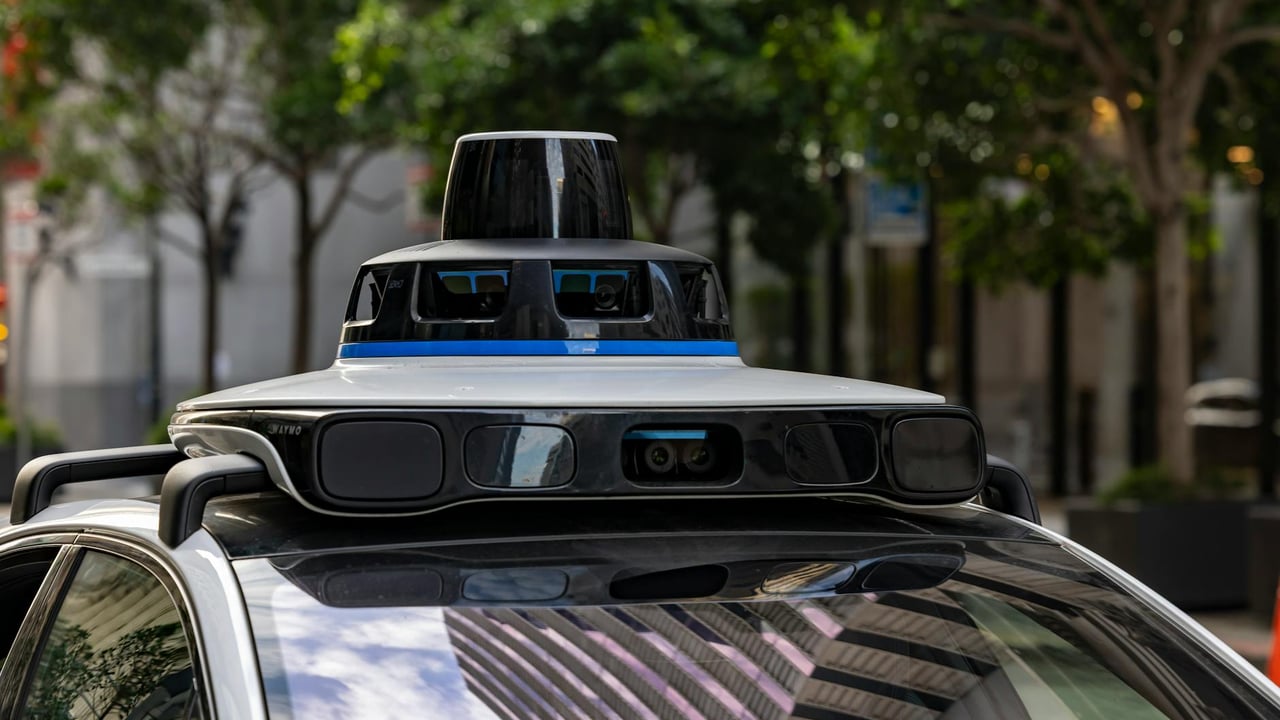

WeRide (文远知行) chief executive Han Xu used an exclusive interview to set out a blunt strategic case: Level‑3 passenger autonomy will not cannibalise Level‑4 Robotaxi businesses, nor will it change WeRide’s focus on scaling pure‑driverless fleets. Fresh from a dual listing in New York and Hong Kong and with licences across eight countries, the company is framing 2026 as a decisive year for autonomous driving and betting on scale, overseas expansion and simulation tools to convert technical demonstrations into profitable services.
The company reports tangible traction. As of January 2026 WeRide had deployed just over 1,023 Robotaxis globally, achieved pure‑driverless operations in Guangzhou, Beijing and Abu Dhabi and expects imminent launches in Dubai, alongside the first Swiss permit for autonomous service. Financially it points to striking unit results: Q3 2025 gross margin surged more than 1,100% year‑on‑year, and the Middle East Robotaxi arm reached operating profitability in 2025 — proof, Han argues, that the unit economics can work where utilization and pricing are right.
Han identifies two structural advantages underpinning China‑based L4 players: the depth of scene data gathered in China’s chaotic mixed‑traffic environments and an industrial supply chain that enables tighter control of hardware costs. China’s streets, with pedestrians, cyclists and dense urban interchanges, have forced systems to learn high‑variance, adversarial scenarios; domestically manufactured, automotive‑grade chips and sensors then allow companies to translate that learning into more affordable, redundant hardware suites.
On the fractious debate between L2++, L3 and L4, Han draws a clear technical line. He rejects the idea that L3 rollout will derail L4 commercialisation, arguing instead that L3 is a simplified form of L4 rather than a straightforward upgrade of L2++. In his view, delivering safe L3 at scale ultimately requires the same pure‑driverless operational capabilities and partnerships between autonomous‑software firms and OEMs that underpin L4 fleets, meaning the two can be complementary rather than directly competitive.
A central part of WeRide’s push is an in‑house simulation platform called GENESIS, a high‑fidelity “world model” that can spin up realistic city simulations in minutes. Han says GENESIS slashes physical data collection and labelling costs by about 75%, accelerates algorithm iteration and lets the company train and stress‑test systems against extreme long‑tail scenarios that are prohibitively expensive or slow to acquire on real roads. The company also embeds diagnostic tools to automatically find and attribute suboptimal driving behaviours, shortening the feedback loop from fault discovery to software patch.
Capital strategy and market focus are pragmatic. WeRide says it holds roughly RMB 5.4 billion in cash — enough, by its estimate, to sustain current operations for nearly a decade — and pursues an “orderly expansion, sustained self‑funding” posture. Near‑term priorities are R&D, overseas markets (particularly the Middle East, Europe and Southeast Asia where service prices and exchange rates can improve returns) and growing fleet scale to 2,000–3,000 Robotaxis in 2026. The longer horizon remains ambitious: tens of thousands of Robotaxis globally by 2030, anchored to the WeRide One software stack and partnerships with platforms such as Uber and Grab.
For international observers the implication is twofold. Technically, WeRide illustrates how simulation and massive scene datasets can compress the path from prototype to city‑level operations. Strategically, it highlights a Chinese competitive model that fuses intensive road testing, domestic supply‑chain cost advantages and early overseas market entry to chase unit economics. The approach improves the odds of profitable autonomous fleets but does not remove regulatory, safety and capital risks: scaling pure‑driverless services requires favorable local rules, robust incident management and continuous capital discipline against a backdrop of global competition.