
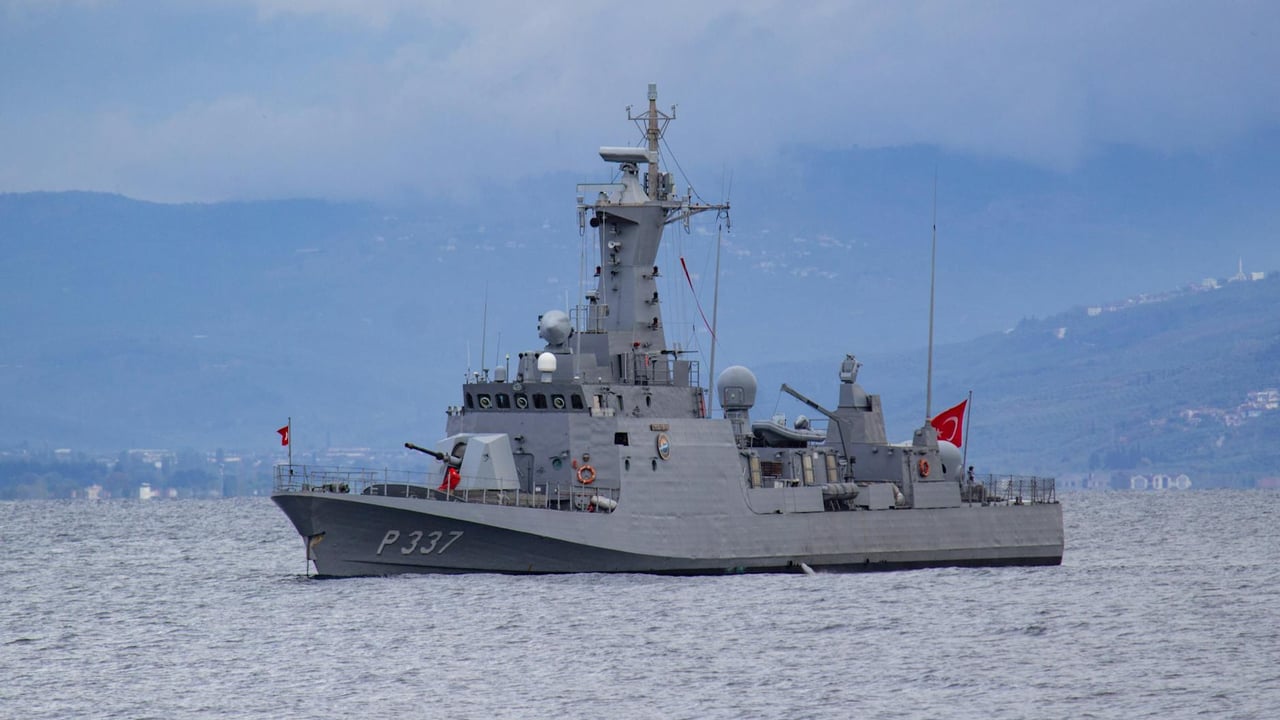

On 9 March 2026 Pakistan launched an armed escort operation named “Maritime Guardian,” dispatching the Chinese-built Type 054A/P frigate Shahjahan into the Gulf of Oman and the eastern approaches to the Strait of Hormuz. The deployment marks the first time a non-aligned state has sent a principal warship into the contested waterway in the current cycle of tensions between Washington and Tehran, and it is explicitly framed by Islamabad as a defensive measure to protect Pakistani-flagged merchant ships and energy imports.
The Strait of Hormuz is central to Pakistan’s economy: roughly 80 percent of its oil and 90 percent of trade transits the route. Recent Iranian restrictions on certain ships and the suspension of war-risk insurance by major underwriters created immediate supply disruptions for Pakistani vessels and acute domestic energy pressure. Islamabad’s decision to put a modern frigate on station is therefore as much about economic security and political signalling as it is about naval tactics.
The Shahjahan is a Type 054A/P variant tailored for Pakistan. The platform gives Islamabad a step-function improvement in endurance and sensor-missile capability compared with its older patrol fleet: a reported 8,000-nautical-mile endurance at 15 knots, a 32-cell vertical-launch system for LY-80N medium-range air defence, CM-302 supersonic anti-ship missiles and an SR2410C active phased-array radar. Pakistani authorities present the ship as fit for long deployments in the high-heat, high-salinity conditions of the Gulf.
But the frigate’s performance is not just a product of hull and missiles; it is enabled by a Chinese logistical and systems backbone. The Shahjahan reportedly integrates a ZKJ-5 combat management system and HN-900 datalink that can be networked with Pakistani air assets such as ZDK-03 early-warning aircraft and JF-17 fighters. That systems continuity reduces the friction of operating far from home and, crucially, lessens Islamabad’s dependence on Western supply chains and political clearances.
Politically, the deployment breaks the near-monopoly of the United States and Iran over naval posture in the Strait. Islamabad has framed its posture as non-aligned: it says it will protect only Pakistani-flagged ships and will not join U.S.-led escort groups nor engage Iranian forces. That posture—practical, narrowly defined and defensively framed—has been welcomed by some regional observers as a stabilising third-party presence that reduces incentives for escalation.
The presence of Pakistani warships in Hormuz also interacts awkwardly with Islamabad’s growing security relationship with Riyadh. Islamabad and Riyadh signed a “Common Strategic Defense Agreement” in 2025 that commits mutual action in the event of a direct attack on either territory. Pakistani officials, however, insist the Hormuz deployment is not the execution of treaty obligations but a sovereign measure to protect trade and energy lifelines.
Operationally the mission highlights both the promise and limits of Pakistan’s new frigates. The Type 054A/P offers a balanced, cost-effective package for convoy protection and local area defence, but its roughly 4,200-ton displacement, single-sided phased-array radar and limited hangar space constrain its ability to sustain high-intensity, multilayered air-defence or anti-submarine warfare in a contested blue-water theatre. Analysts in Islamabad say that shortfalls in long-range air defence, anti-submarine reach and command-of-the-sea power will eventually need addressing.
That is why many Pakistani voices are already pointing to larger acquisitions: a Type 052DE-class destroyer or comparable platforms would provide expanded radar coverage, longer-range air-defence and a more credible task-group command ship. Paired with the existing 054A/P frigates, such a high-low mix would underpin a permanent Pakistani presence in distant chokepoints and reduce vulnerability to saturation attacks or submarine threats.
For regional security the operation could be catalytic. It may encourage other middle powers to consider independent escort duties for their vessels or to form ad hoc coalitions modelled on the Gulf of Aden counter-piracy campaigns. At the same time, more actors operating in proximity to U.S., Iranian and coalition naval forces raises the risk of miscalculation, ambiguous encounters and competing rules of engagement in a narrow maritime corridor.
In short, Pakistan’s dispatch of a Chinese-built frigate to Hormuz is a statement of intent: to defend national lifelines, to project a limited but permanent maritime presence, and to demonstrate an alternative security model for states unwilling to rely exclusively on Western naval umbrellas. The initiative reduces the binary logic of the current standoff, but it also exposes Islamabad to hard choices about fleet structure, logistics and the diplomatic tightrope of operating between larger powers.