
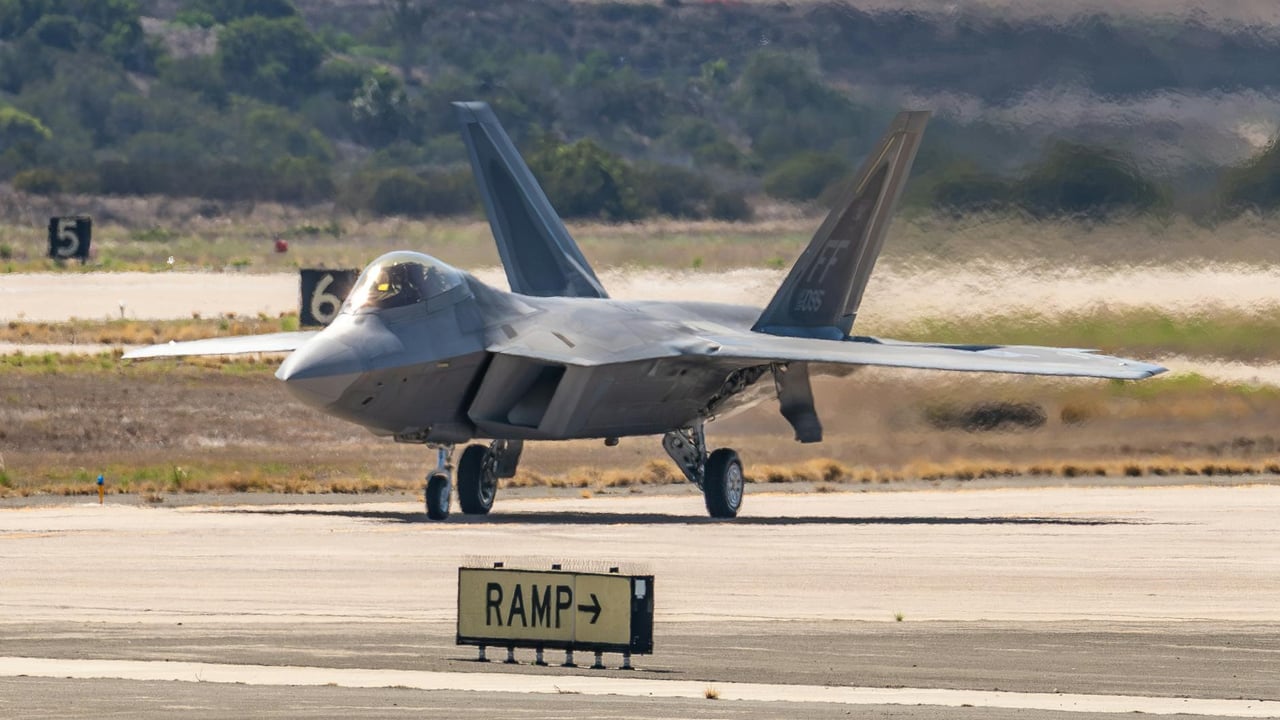

Lockheed Martin has publicly unveiled a conceptual ‘F‑22 2.0’ upgrade at the Air Force Association’s annual symposium, presenting a model that the US Air Force plans to use as the baseline for modernising its entire F‑22 fleet. The package is presented explicitly as a response to advancing fifth‑generation fighters fielded by other countries, and it targets two long‑standing limitations of the Raptor: limited range/operational radius and the absence of an internal infrared search-and-track (IRST/EOTS) sensor.
The original F‑22 design prioritised stealth and air superiority in contested airspace, but its relatively short combat radius and lack of an integrated passive electro‑optical sensor have been recurring operational concerns, particularly for missions in the vast distances of the Indo‑Pacific. Lockheed’s public model signals an attempt to keep the type relevant against newer adversary platforms without resorting to a wholly new airframe, by incrementally improving endurance and situational awareness.
Adding an internal IRST would be a significant capability shift. Passive IRST systems can detect and track aircraft without emitting signals that reveal the platform’s location, thereby complementing radar and missile warning systems and offering a way to detect low‑observable targets in certain engagement geometries. Extending range or combat radius would also broaden the Raptor’s mission set, reducing reliance on aerial refuelling and increasing reach for long‑range patrols or intercepts.
Lockheed and the Air Force have not released exhaustive technical details in this initial public showing, so the precise engineering fixes remain to be seen. Possible measures could include internal fuel reconfiguration, conformal fuel tanks, aerodynamic refinements, avionics and power‑management upgrades, or sensor redesigns, but each option has trade‑offs for stealth, weight and maintenance. The programme will face schedules, cost estimates and platform life‑extension questions as the service moves from concept to fielding.
Strategically, the upgrade programme reflects a pragmatic US approach to maintaining technological edge: modernise proven airframes rather than build in large numbers from scratch. It also sends a clear signal to competitors that Washington intends to preserve the F‑22’s edge even as adversaries iterate on their own stealth fighters. Yet upgrades alone do not address the broader challenge of fleet size; persistent industrial limitations that curtailed F‑22 production decades ago mean America must balance capability improvements with the reality of a limited number of Raptors.
The unfolding F‑22 2.0 debate will intersect with other US defence priorities: funding choices between upgrades and new platforms, the tempo of sensor and engine development, and the operational concepts for contested environments in the Indo‑Pacific. If executed well, the programme could extend the Raptor’s relevance into the 2030s, but it will also test whether evolutionary improvements can keep pace with the rapid rate of change in fifth‑generation and counter‑stealth technologies worldwide.