
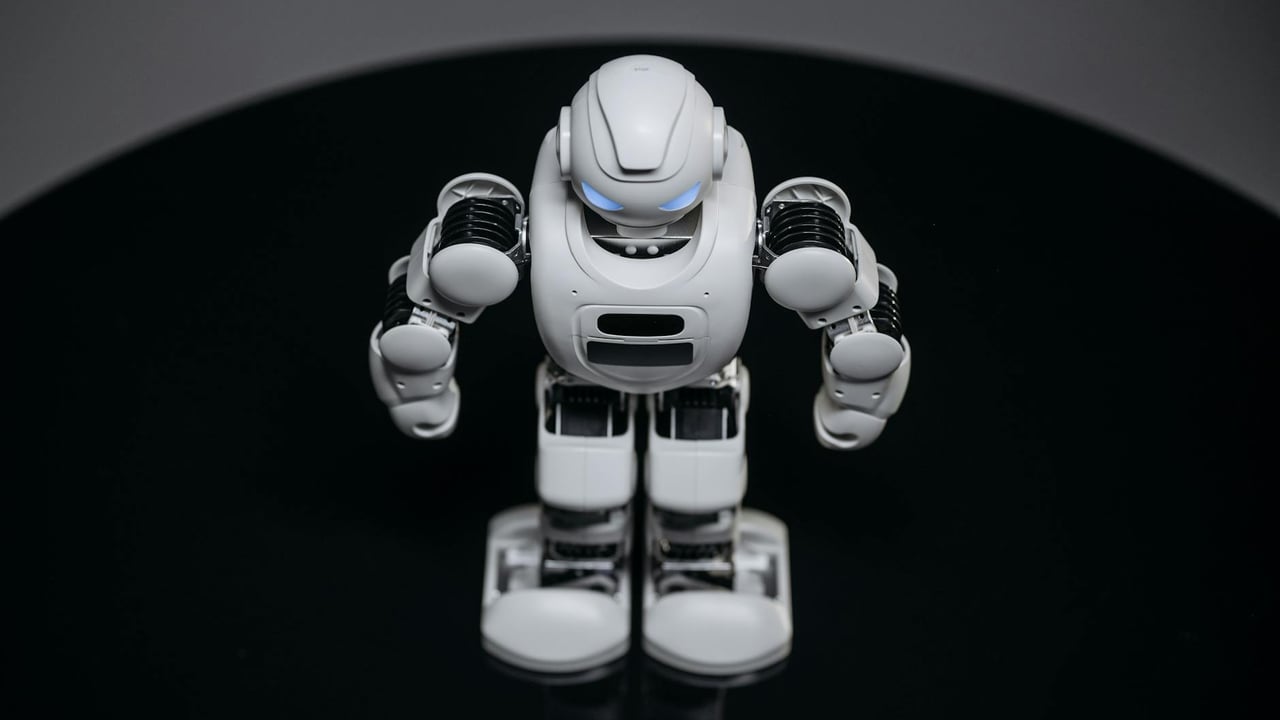

A Beijing research team working with Tsinghua University has unveiled what it calls the world’s first fully autonomous humanoid tennis robot capable of continuous rallies with a human opponent. Standing about 1.75 metres tall, the machine uses a proprietary LATENT control algorithm and deep reinforcement learning to acquire tennis skills without task-specific preprogramming, the developers say.
The robot’s dual-camera vision system can lock on to incoming balls in about 0.1 seconds and track shots exceeding 50 km/h. In demonstration footage the robot achieves a forehand hit success rate of 90.9% and sustains more than 20 consecutive exchanges with a human player, metrics that the team highlights as evidence of robust perception, timing and dynamic motor control.
The video circulated widely after being reshared and liked by Elon Musk; Andrej Karpathy, a well-known AI researcher, wrote that he initially assumed the clip was AI-generated before realising it was real. Their reactions amplified interest in a development that sits at the intersection of robotics, embodied artificial intelligence and real-world sensorimotor learning.
The achievement matters because embodied intelligence — systems that sense, decide and act in the physical world — has long lagged behind advances in large language models and other virtual AI. Tennis is a demanding testbed: it requires millisecond-scale visual processing, rapid trajectory prediction, precise whole-body coordination and continuous adaptation. Demonstrating these capabilities outside carefully controlled lab conditions is a significant technical milestone.
That said, the demonstration is a single-specimen showcase rather than proof of a broadly deployable humanoid. Video demonstrations can be curated; robustness to varied opponents, outdoor conditions, prolonged use, battery life and safety around unpredictable humans remain open questions. Commercialising humanoid robots also depends on cost, maintainability and the ability to generalise learned skills across tasks.
In the global robotics landscape the Tsinghua-linked project complements work by well-known players such as Boston Dynamics and a host of smaller startups experimenting with reinforcement learning, sim‑to‑real transfer and advanced sensor fusion. The immediate commercial derivatives are likelier to be specialised: sport-training partners, testing rigs for control algorithms, or advanced research platforms, rather than household humanoids or widespread industrial replacements.
For policymakers and industry leaders the demonstration is a reminder that progress in AI is increasingly physical. Investors may accelerate funding for embodied AI, while regulators and venues that manage public interactions with robots must prepare safety standards and liability frameworks. The short-term impact will be energetic attention and R&D momentum; the long-term question is whether such demonstrations translate into durable, scalable systems that operate reliably and safely in everyday human environments.