
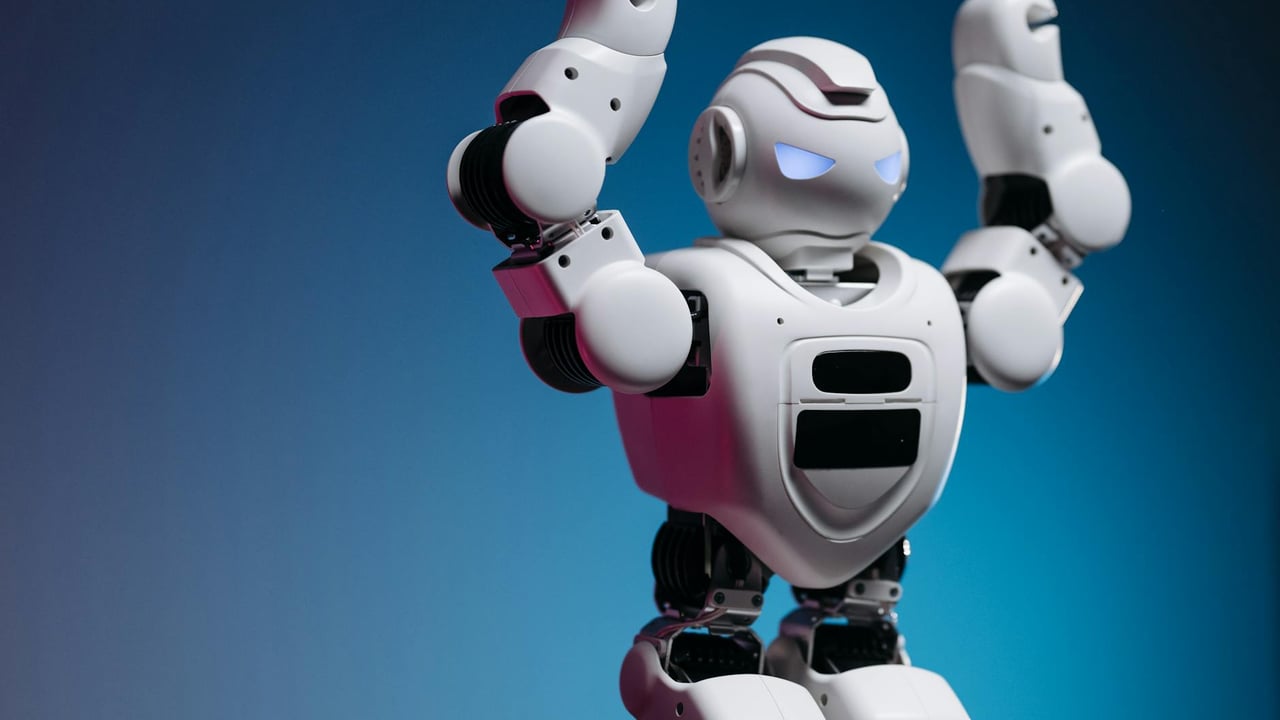

Wang Xingxing, founder of Beijing-based robotics firm Yushu Technology, has staked a provocative claim: within the year, legged robots should be able to run faster than people, even surpassing the top speeds recorded by elite sprinters. His remark — part boast, part forecast — captures an industry confidence that recent hardware and control breakthroughs are nudging robots past long‑standing physical limits.
Wang delivered the prediction amid wider debate about when embodied artificial intelligence will achieve a ‘ChatGPT‑style’ inflection point. He tempered the speed claim with a longer horizon for general embodied intelligence, estimating that a true convergence of large‑model reasoning and robust physical autonomy may still be two to three years away. That distinction — raw locomotion versus general, adaptive intelligence in the real world — is central to how engineers and investors evaluate progress.
The timing matters because the robotics field has recorded conspicuous milestones recently: agile quadrupeds and hexapods performing acrobatics, humanoid prototypes executing near‑human motions, and electronics and actuators becoming lighter and more power efficient. Western and Chinese teams alike have been racing to translate simulation success into reliable performance in noisy, unpredictable environments. Speed, in this sense, is an easily communicated metric that signals broader advances in motors, control algorithms and perception.
But technical hurdles remain. Top sprint speeds are a narrow achievement; sustaining speed, recovering from perturbations, managing energy consumption and integrating sophisticated decision‑making are separable problems. A robot that can hit a high top speed on a flat track is not the same as a machine that can navigate crowded streets, respond to unexpected contact, or plan complex tasks without human direction. Data requirements for robust embodied AI — large, well‑labelled datasets of real interactions — also remain a bottleneck.
Wang’s public optimism is consequential beyond headline‑grabbing one‑liners. It signals to investors, customers and policy makers that Chinese robotics companies are moving from laboratory experiments toward deployable systems. That shift will accelerate conversations about regulation, workplace impacts and military applications. If legged robots become measurably faster and more reliable, their potential roles in logistics, search and rescue, surveillance and industrial automation expand rapidly.
The forecast is also a test of hype versus substance. Overpromising has been common in robotics, from grand claims about household humanoids to sweeping timelines for general autonomy. Observers should parse achievements carefully: incremental but cumulative improvements in actuators, perception stacks and on‑device models may yield dramatic demonstrations, yet broad utility and safety take longer to mature. For now, speed is a headline; robustness and autonomy will determine economic and social impact.
In short, Wang’s assertion points to real technical momentum and a shifting competitive landscape. Whether the next twelve months deliver a world where robots routinely outpace humans on speed alone is uncertain; what is more likely is continued, visible progress that forces societies to grapple with how fast such machines should be deployed and governed.