
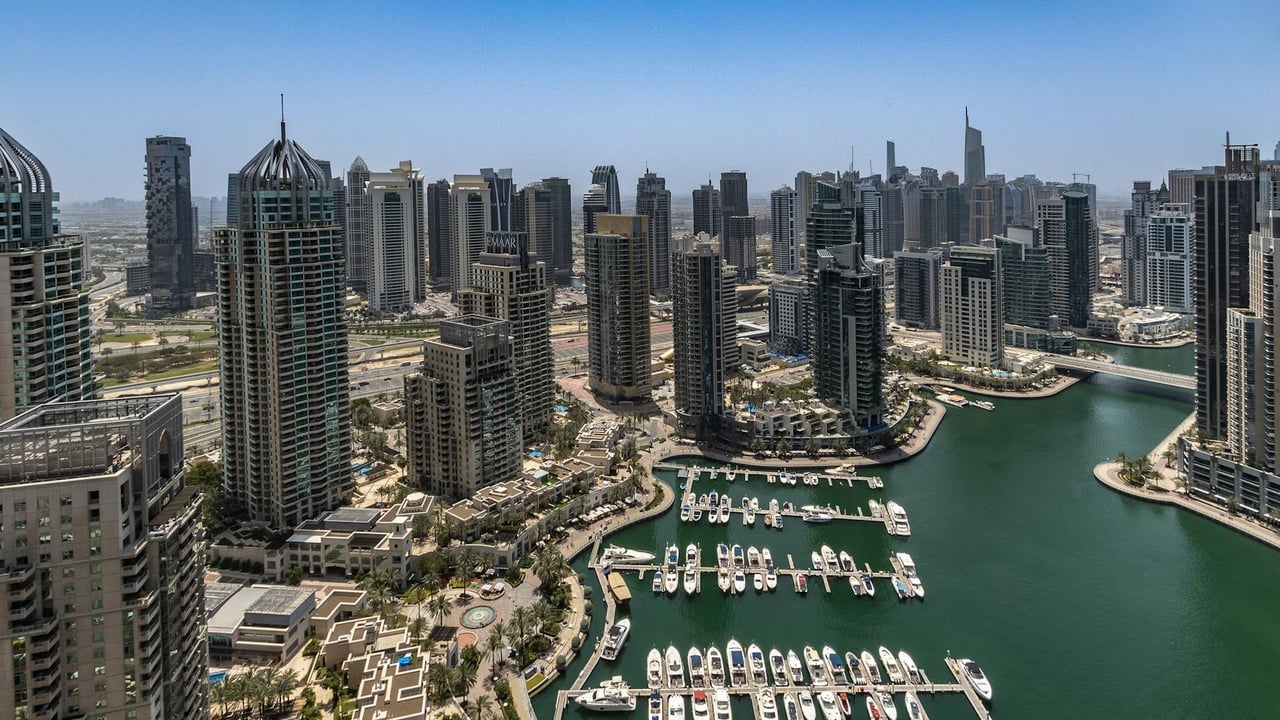

On March 16 a drone struck a fuel storage tank near Dubai International Airport, igniting flames and black smoke and forcing a temporary suspension of flights. The strike was one of several incidents in a wave of unmanned and missile attacks that have punctured the sense of invulnerability around the city’s gleaming skyline and vital transport hubs.
UAE air defenses report having intercepted hundreds of incoming threats: by March 1, authorities say they had shot down 541 drones, 165 ballistic missiles and two cruise missiles. Landmarks long treated as symbols of Dubai’s resilience — the airport, the Burj Al Arab and even the Burj Khalifa — have been threatened or struck, and high‑rise office and residential blocks are now within sight of incoming ordnance.
The market reaction has been swift. Dubai’s real‑estate index (DFMREI), which also reflects publicly traded property firms, plunged more than 30 percent in a matter of weeks, while transaction volumes and values collapsed: in the 10th week of 2026 sales fell 44.5 percent and total deal value dropped 49.9 percent. Price correction that began before the conflict has accelerated; apartment prices that peaked in August 2023 at roughly RMB 32,000 per square metre were about 10 percent lower by February 2026, and specialist indices have taken a heavier hit since the attacks escalated.
The scale of the unwind matters because Dubai’s recent boom was not incidental. Over five years villas appreciated by roughly 147 percent and 2025 saw a 25 percent increase in property sales, while nearly 9,800 new millionaires were recorded that year. The emirate’s open, lightly taxed property market has become a global repository for wealth: foreigners own about 43 percent of Dubai’s property assets, with buyers from India, the UK, Pakistan, Saudi Arabia and Iran prominent among them.
That concentration of external capital is part of Dubai’s business model — it is a global financial hub and a “safe harbour” for mobile wealth, with oil contributing a fraction of local GDP. Yet that same openness makes the emirate vulnerable to sudden reversals. Non‑oil sectors account for most of the economy and real estate alone is responsible for roughly 15 percent of non‑oil activity; about 90 percent of Dubai’s population are expatriates, while a small wealthy minority owns a disproportionate share of property.
Faced with missiles overhead, many of the ultra‑wealthy are voting with their feet. Anecdotes of private jets charging tens of thousands of dollars per seat, and family offices arranging six‑figure charters to relocate clients, underscore a rapid reallocation of people and assets. Financial centres from London and New York to Hong Kong and Singapore are actively courting defecting clients — a migration that could redistribute high‑net‑worth money and recalibrate demand in global luxury property markets.
The political economy of the shock is consequential. If a significant share of mobile capital and resident elites decamp permanently, Dubai risks a prolonged slump in property prices that would ripple through construction, finance, tourism and service sectors. Authorities have fiscal room relative to oil‑dependent peers, but the speed and scale of capital flight will test policy options: from liquidity injections and regulatory forbearance to incentives aimed at keeping owners tied to the market.
For now the outcome is uncertain. Short‑term price volatility and evaporating transaction volumes point to a painful adjustment, but Dubai’s fundamentals — visa regimes, tax advantages and geographic connectivity — will complicate any simple prediction of permanent decline. What is clear is that the era of untroubled, geopolitically insulated real‑estate booms in the Gulf may be over: luxury housing is proving as much a geopolitical as an economic asset.