
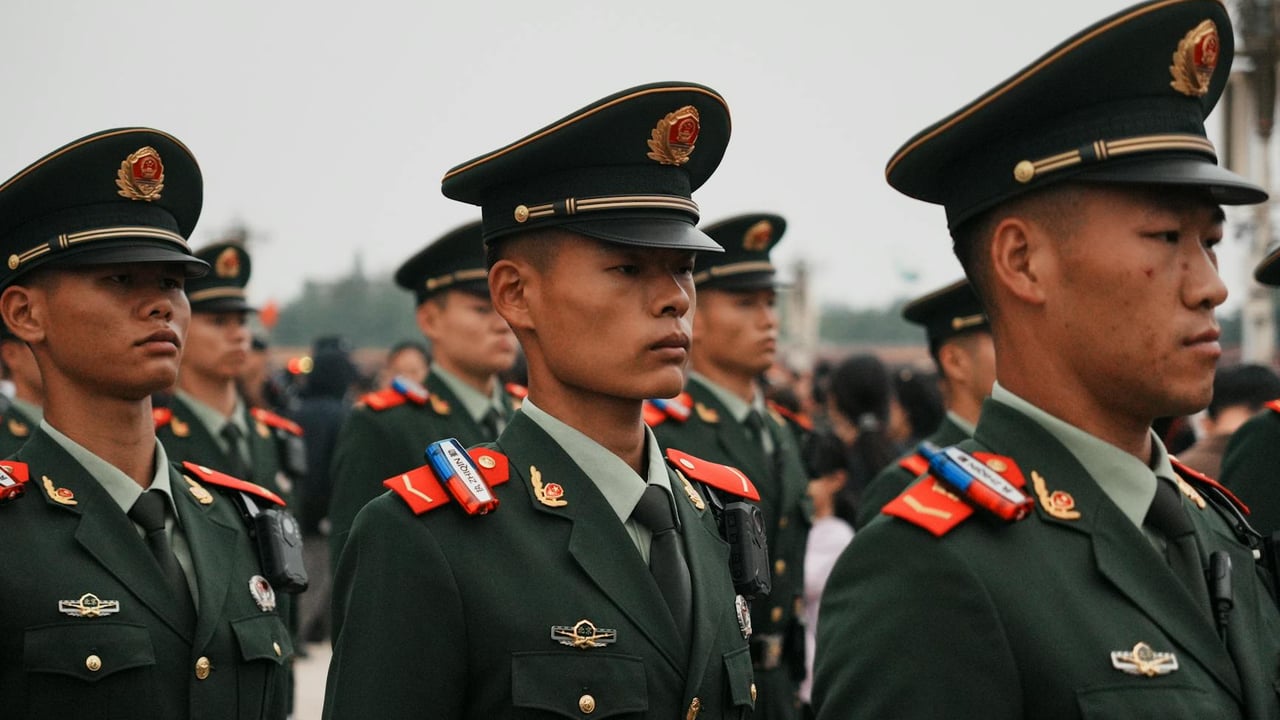

In a seemingly mundane encounter on a Beijing thoroughfare, a group of uniformed People’s Liberation Army (PLA) soldiers paused while crossing the street to salute a driver who had yielded the right of way. The incident, captured and circulated widely on Chinese social media, has sparked a wave of nationalistic fervor and public discourse regarding the evolving image of the Chinese serviceman. For the driver involved, the gesture was described as 'deeply impactful,' a sentiment that resonates with a domestic audience increasingly conditioned to view the military as the ultimate vanguard of social order and moral rectitude.
This interaction is far more than a simple act of courtesy; it is a calculated manifestation of the 'Fish and Water' doctrine that has long defined the relationship between the Chinese Communist Party’s armed wing and the civilian population. Historically rooted in Mao Zedong’s 'Three Rules of Discipline and Eight Points for Attention,' the modern PLA is undergoing a sophisticated branding transformation. Under the current leadership, there has been a concerted effort to move beyond the image of a massive peasant army toward a highly disciplined, professional force that is both feared by adversaries and revered by its own citizens.
Recent years have seen the Chinese government pass comprehensive laws aimed at protecting the 'honor and dignity' of military personnel, effectively elevating their social status to a protected class. These legal frameworks, combined with highly publicized moments of civic virtue like the crosswalk salute, serve to solidify the social contract between the state and the people. By showcasing a military that is both powerful and polite, the state reinforces the narrative that the PLA is the benevolent protector of the 'Chinese Dream.'
Furthermore, the viral nature of this event highlights the role of digital propaganda in modern China. Small, grassroots interactions are frequently amplified by state-aligned media outlets to create a pervasive sense of national unity and moral superiority. In an era of heightened geopolitical tension, these domestic displays of discipline and mutual respect serve as an internal stabilizer, ensuring that the civilian population remains emotionally and ideologically tethered to the nation’s military apparatus.