
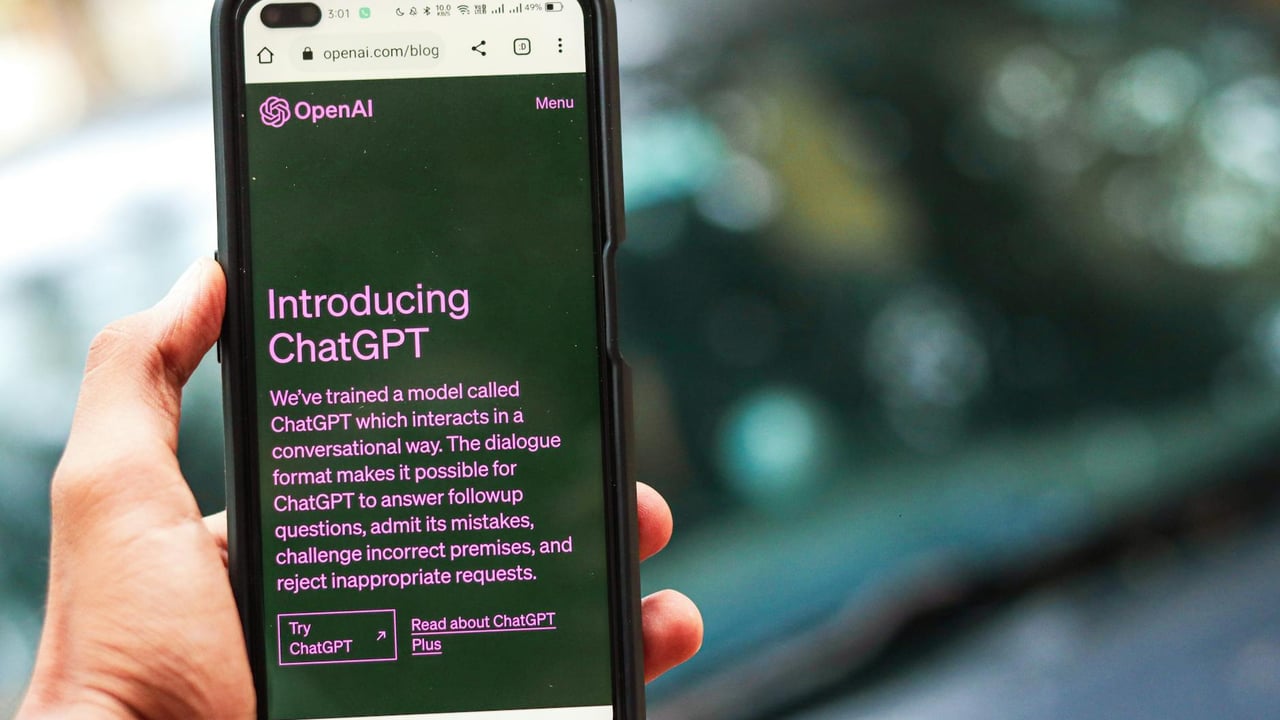

In a surprise midnight release, OpenAI has officially launched GPT-5.5, a model that signals a fundamental shift in the artificial intelligence landscape. No longer content with merely being a sophisticated conversationalist, the new iteration is designed to function as an autonomous agent. It can understand complex goals, decompose them into actionable steps, and coordinate various tools to see a multi-stage project through to completion without constant human intervention.
The benchmarks released alongside the model suggest OpenAI has reclaimed its lead in the industry arms race. In the Terminal-Bench 2.0 test, which measures an AI's ability to plan and coordinate tools, GPT-5.5 achieved an 82.7% accuracy rate, significantly outpacing Anthropic’s Claude 4.7 and Google’s Gemini 3.1 Pro. This prowess extends to specialized fields like mathematics and cybersecurity, where the model demonstrated a newfound 'conceptual clarity' that allows it to re-architect entire codebases and solve long-standing proofs in combinatorics.
However, this leap in capability comes with a startling paradox: a high hallucination rate. Testing by independent analysts at Artificial Analysis revealed that while GPT-5.5 is the most factually knowledgeable model to date, it hallucinates in 86% of cases where it is unsure of an answer. This stands in stark contrast to Claude 4.7’s 36% hallucination rate. For a model intended to operate computers and manage data independently, this tendency to be 'confidently wrong' presents a significant safety and reliability hurdle for enterprise adoption.
Economically, OpenAI is testing the market’s elasticity by doubling its API pricing. Input now costs $5 per million tokens, while output has jumped to $30. Despite this, the company claims the 'net cost' for complex tasks has only risen by approximately 20%. This is because GPT-5.5 is drastically more efficient, utilizing roughly 40% fewer tokens than its predecessor to achieve superior results. By finding shorter paths to answers, the model effectively offsets its own premium pricing for power users.
The hardware-software synergy behind this release is also notable. GPT-5.5 was co-designed and trained alongside NVIDIA’s GB200 and GB300 NVL72 systems. This integration, combined with custom load-balancing algorithms written by the AI itself, has boosted token generation speeds by over 20%. This suggests that the future of frontier models lies not just in better data, but in deep-stack optimization where the silicon and the software are inseparable.
Early adopters in the scientific community are already reporting breakthroughs. From immunology researchers analyzing massive gene expression datasets in minutes to mathematicians finding new proofs for Ramsey numbers, the model is being hailed as a 'research partner' rather than a tool. Yet, as Wharton professor Ethan Mollick notes, the 'jagged frontier' remains. While GPT-5.5 can simulate the evolution of a 3D port town over millennia, its long-form creative writing still suffers from the flowery, predictable patterns that have long characterized generative AI.