
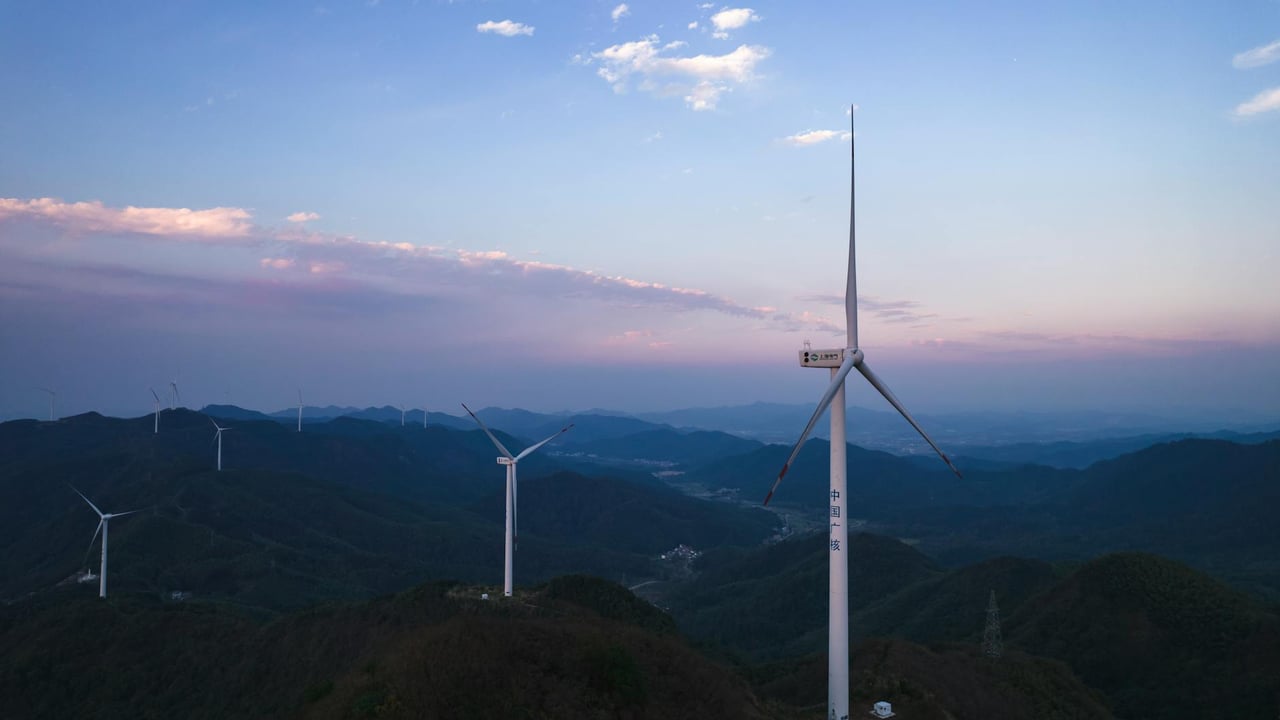

Deep in the Tengger Desert, where shifting sands once choked the historic Hexi Corridor, a new industrial logic is taking root. Over the past three years, China’s state-owned enterprises (SOEs) have transformed hundreds of thousands of acres of wasteland into a 'photovoltaic sea.' This is not merely an environmental reclamation project; it is the cornerstone of a 2,000-kilometer infrastructure corridor that links renewable energy directly to the insatiable appetite of artificial intelligence.
The strategy rests on a triad of sand, power, and computation. By placing massive solar and wind arrays on 'worthless' desert land, firms like China Energy and PowerChina are generating vast quantities of cheap, green electricity. This power is then fed into ultra-high-voltage lines—such as the 1,616-kilometer 'Ningxia-to-Hunan' link—or consumed locally by a burgeoning network of data centers in hubs like Zhongwei and Qingyang. In these remote outposts, the natural cold of the Northwest acts as a giant radiator, bringing Power Usage Effectiveness (PUE) levels down to near-theoretical limits.
China’s 'East Data, West Computing' initiative is evolving rapidly. While the original plan focused on 'cold' data—backups and archival storage—the explosion of large language models has shifted the focus to 'hot' computation. Tech giants like Tencent, ByteDance, and Alibaba are increasingly moving massive AI training tasks to the desert. The economics are undeniable: with electricity prices nearly 40% lower than in eastern coastal cities, a single 10,000-GPU cluster can save tens of millions of dollars in annual operating costs.
This grand integration is a uniquely state-led phenomenon. The scale of investment—trillions of yuan across power grids, data centers, and land remediation—is too vast for the private sector to bridge alone. China’s central SOEs are operating as 'patient capital,' absorbing short-term depreciation and financing costs to build 'new productive forces' years before they become profitable. They are effectively subsidizing the digital infrastructure that will underpin China’s AI competitiveness for the next decade.
However, the map is not yet complete. Significant bottlenecks remain, particularly regarding latency; while the West is ideal for model training, the 20-millisecond delay to coastal hubs still hampers real-time AI inference. Furthermore, the transition to a fully market-based electricity pricing system in 2025 will test the financial resilience of these state-led projects. As China bets its future on this high-tech desert corridor, it is discovering that building the grid is only half the battle; the real challenge lies in orchestrating the complex market mechanisms to keep it running.