
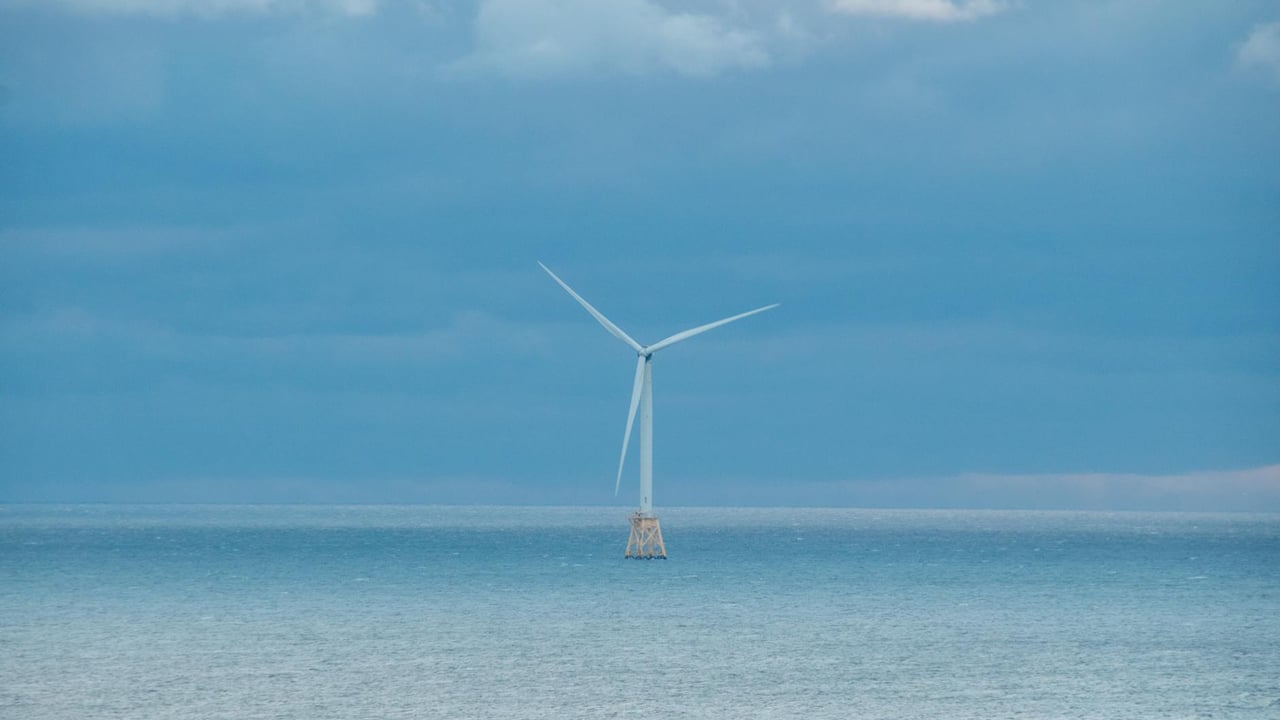

China has achieved a significant engineering milestone in its quest for renewable energy dominance with the successful installation of the "Sanxia Linghang" (Three Gorges Pilot). Located in the waters off Yangjiang, Guangdong province, this 16-megawatt behemoth stands as the world’s largest single-unit capacity floating offshore wind platform. The deployment marks a decisive shift for China’s energy sector, moving beyond the shallow-water constraints of traditional fixed-bottom turbines and into the untapped potential of the deep sea.
The scale of the Sanxia Linghang is staggering, featuring a turbine with a rotor diameter of 252 meters. To visualize the magnitude, its sweep area covers approximately 50,000 square meters, equivalent to seven standard football pitches. Reaching heights of over 270 meters, the structure is designed to capture the more powerful and consistent wind currents found further away from the coastline, where traditional foundations are no longer economically or technically feasible.
Unlike conventional turbines that are bolted to the seabed, this unit sits atop a massive semi-submersible platform with a displacement of 24,100 tons. Stability in the volatile South China Sea is maintained through a sophisticated mooring system consisting of nine suction anchors and high-performance, domestically produced polyester fiber cables. This technical configuration allows the platform to withstand extreme maritime conditions while maintaining precise positioning, a critical requirement for deep-water power generation.
This project represents more than just a capacity record; it highlights the rapid maturation of China’s high-end maritime manufacturing supply chain. From the super-sized blades to the specialized mooring chains, the integration of domestic technology underscores Beijing’s strategic focus on "technological self-reliance." As the global wind industry looks toward floating technology as the next frontier, China is positioning itself as the primary architect and equipment provider for the world’s deep-sea energy transition.