
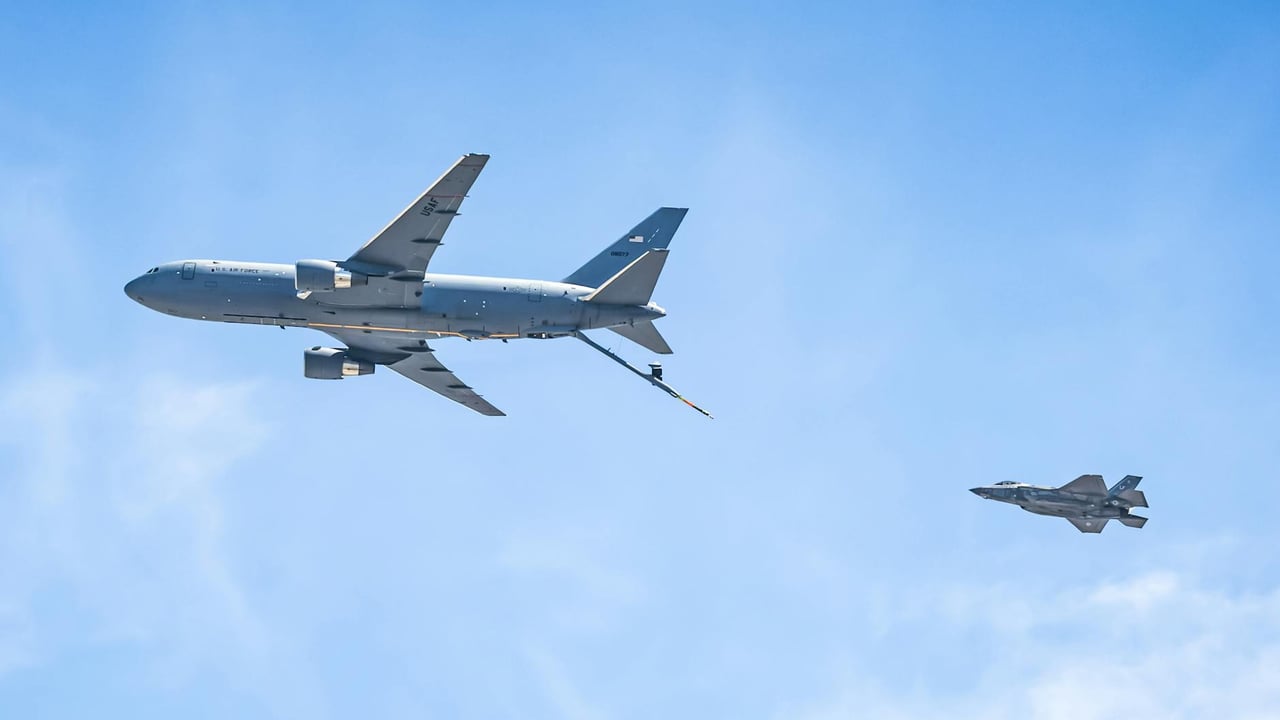

The aftershocks of the February 2026 'Operation Epic Fury' continue to reverberate through the halls of the Pentagon and the Kirya. While the joint U.S.-Israeli air campaign against Iran achieved its primary objectives, it also laid bare a critical structural vulnerability: the fragility of the coalition's aerial refueling infrastructure. This logistical bottleneck, often overlooked in favor of high-tech strike platforms, nearly compromised the mission as combat aircraft faced severe fuel exhaustion over hostile territory.
In the opening six days of the operation, the Israeli Air Force (IAF) conducted over 550 refueling missions, a tempo that stretched its fleet of seven aging Boeing 707 tankers to the breaking point. Despite American support, several F-35I 'Adir' fighters were forced into emergency landings after nearly exhausting their fuel reserves during the 2,200-kilometer return flight from Tehran. The inherent range limitations of the F-35—approximately 1,127 kilometers on internal fuel—have long necessitated at least one mid-air top-off for deep-strike missions into the Iranian heartland.
Washington’s response to these shortfalls involves doubling down on the troubled Boeing KC-46 Pegasus program. In late 2025, Boeing secured a $2.47 billion contract for 15 additional units, bringing the total fleet goal toward 188 aircraft. However, the Pegasus remains plagued by technical grievances, including issues with its Remote Vision System (RVS) and stiff refueling booms. The U.S. Air Force is currently forced to maintain 375 ancient KC-135s, some of which have served for over six decades, resulting in skyrocketing maintenance costs and frequent mission delays due to mechanical failure.
Israel is taking a more pragmatic, localized approach by modifying its aircraft rather than waiting for a massive fleet expansion. Jerusalem recently signed a $34 million contract with Elbit Systems to integrate low-drag, low-observable external fuel tanks for the F-35I. By increasing the internal fuel capacity by roughly 40%, the IAF aims to extend the 'Adir's' combat radius beyond 1,600 kilometers. This tactical shift reduces the dependency on a handful of vulnerable tankers and allows for greater operational flexibility in the face of persistent Iranian air defenses.
While the addition of external tanks slightly increases the radar cross-section of the F-35I, Israeli planners argue the trade-off is manageable given the degraded state of Iranian radar networks post-conflict. Furthermore, the tanks are designed to be jettisoned before entering high-threat zones, allowing the jet to regain its full stealth profile for the final strike. This divergent strategy—U.S. industrial scale versus Israeli field-tested modification—highlights the different pressures facing both nations as they prepare for the next phase of Middle Eastern volatility.