
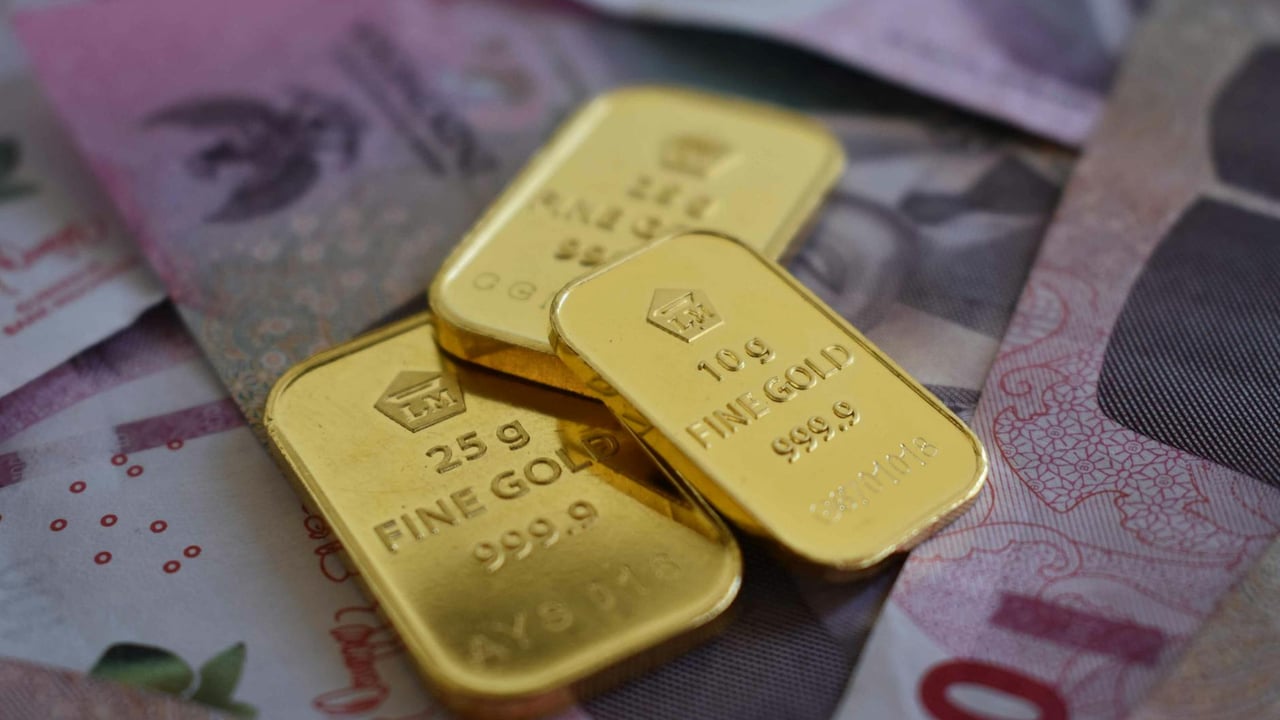

The international gold market has entered a period of intense volatility as spot prices oscillate around the $4,550 per ounce mark, briefly dipping below the psychological $4,500 threshold. This turbulence arrives amid a sharp escalation in rhetoric between Washington and Tehran, with the White House reportedly weighing military options that could further destabilize the Middle East. Investors are currently caught in a high-stakes tug-of-war, balancing the metal's traditional role as a safe haven against the risks of higher interest rates driven by persistent inflation.
Wall Street’s titans are increasingly divided on where the precious metal goes from here, reflecting broader uncertainty about the global macro environment. JPMorgan recently adjusted its 2026 average price forecast downward to $5,243 per ounce, citing a distinct lull in short-term demand. Analysts there point to stagnant trading activity, low COMEX futures volume, and lackluster ETF inflows as evidence that the immediate momentum which propelled gold to record highs may be dissipating.
In contrast, Goldman Sachs remains steadfastly bullish, reiterating a year-end target of $5,400 per ounce. Their optimism is rooted in a fundamental reassessment of central bank behavior, which they argue has been significantly underestimated by traditional tracking methods. By revising their methodology to capture previously "hidden" flows, Goldman analysts suggest that official sector buying is far more robust than the market realizes, providing a structural floor that protects against deep sell-offs.
China remains a pivotal actor in this narrative, with the People’s Bank of China extending its gold-buying streak to eighteen consecutive months as of April 2026. This persistent accumulation reflects a broader strategic pivot among emerging economies to diversify reserves away from the US dollar. As the World Gold Council reports a 3% year-on-year increase in global central bank net purchases, the demand from official sectors is effectively counteracting the tepid interest from private retail investors.
Ultimately, the gold market is currently trapped between two conflicting fears: geopolitical anxiety and the risk of an inflationary spiral. While rising yields typically make non-yielding assets like gold less attractive, the threat of a growth slowdown could eventually force central banks into a more accommodative stance. Until there is more clarity on the trajectory of both the US-Iran conflict and global monetary policy, gold is likely to remain in its current, albeit elevated, holding pattern.