
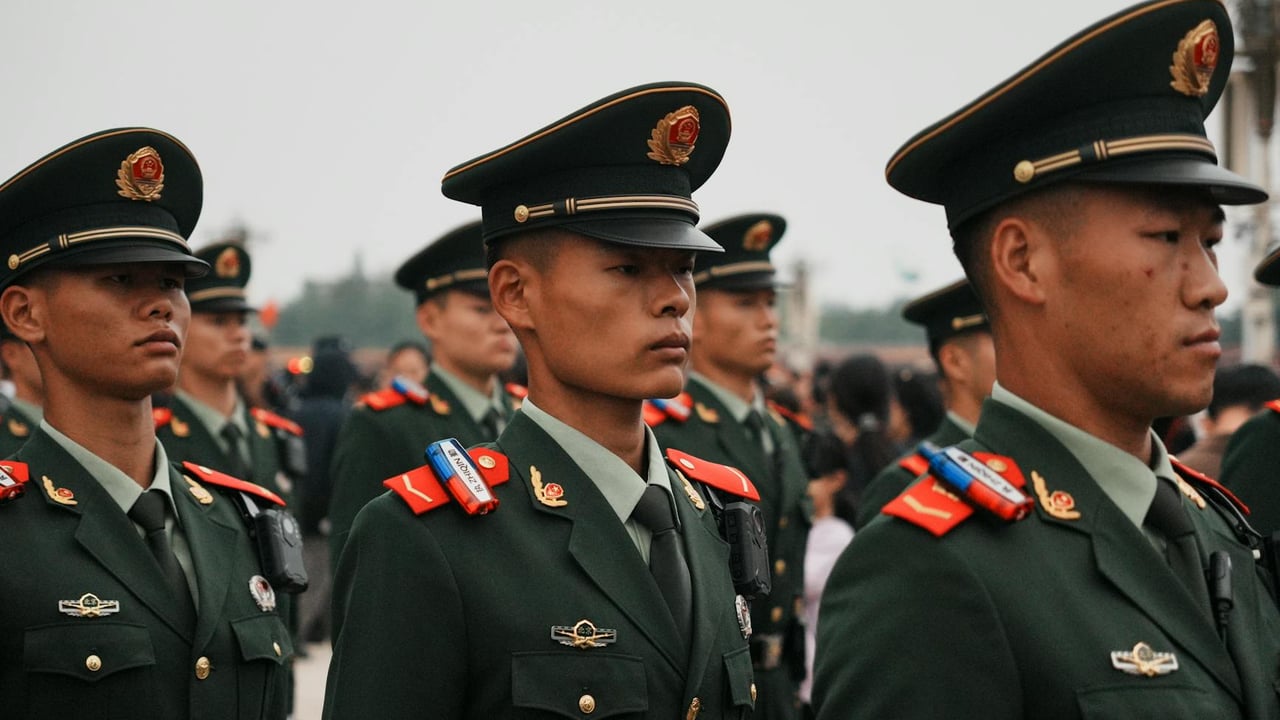

As the engines of Air Force One roared onto the tarmac in Beijing, a single figure captured the attention of the global internet: a Chinese soldier standing in a state of absolute, preternatural stillness. While the massive jet taxied past, the guard remained so motionless that he appeared to be part of the landscape, a stark contrast to the dynamic mechanical power on display. This viral moment has since been elevated by Chinese state media as more than a feat of physical endurance; it is framed as a visual metaphor for the country's rising geopolitical weight.
Colonel Jiang Bin, a spokesperson for the Ministry of National Defense, characterized the soldier's performance as an embodiment of the People’s Liberation Army's (PLA) "confidence, foundation, and composure." In the lexicon of the modern Chinese military, such discipline is described as being 'as steady as a mountain,' serving as an ideological signal to both domestic and foreign audiences. The soldier in the video has been identified as 23-year-old Liu Zhencheng, a member of the People’s Armed Police Beijing Corps, tasked with the high-stakes duty of guarding the 'National Gateway.'
These soldiers, known as the 'First Sentinels,' undergo a training regimen that borders on the ascetic to maintain the image of the Chinese state during high-level diplomatic arrivals. Their protocol, known as the 'Four Nos,' requires them to remain stationary even under extreme provocation: no blinking in high winds, no squinting in dust storms, no wiping sweat in sweltering heat, and no movement even when bitten by insects. This level of physical control is designed to project an image of a military that is perfectly synchronized and psychologically impenetrable.
Beyond the aesthetic of the honor guard, the training emphasizes a dual role of ceremonial excellence and operational vigilance. While appearing like statues, these guards are trained to be 'acutely aware of all directions,' ready to transition from total stillness to rapid response in the event of a security breach. For Liu Zhencheng and his unit, the individual soldier is seen as a microscopic representation of the nation's 'first image,' where a single blink could be interpreted as a lapse in national resolve.