

Recent drills in the Western Pacific have provided a rare, high-definition look into the evolving operational capacity of the People’s Liberation Army Navy (PLAN). While the Liaoning carrier strike group often commands the spotlight, the deployment of the Type 075 amphibious assault ship Anhui signals a critical maturation of China’s expeditionary warfare capabilities. This recent footage confirms that the PLAN is no longer just building hulls; it is successfully integrating the complex 'air-sea-land' elements required for modern littoral combat.
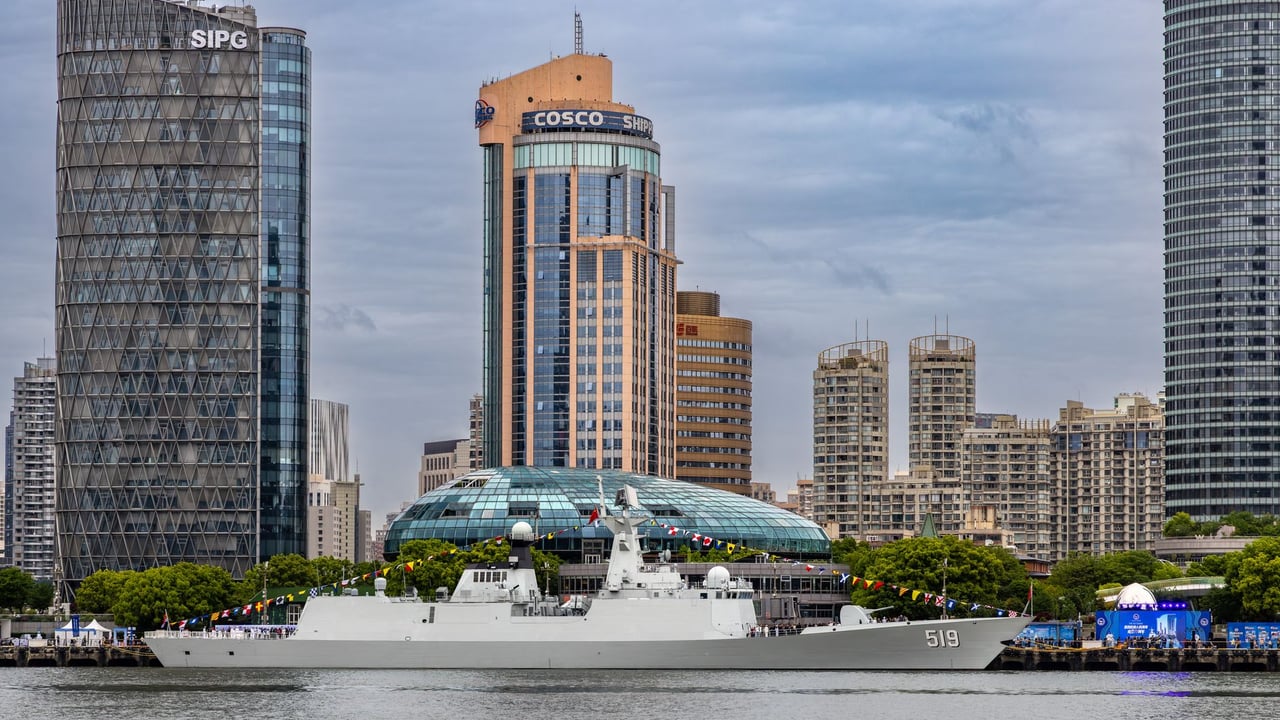
The Anhui was observed operating in an Amphibious Ready Group (ARG) configuration, accompanied by the Type 054A frigate Anyang. This pairing mirrors the U.S. Navy’s traditional ARG structure, where a capital ship provides the primary transport and aviation punch while a versatile escort manages local air defense and anti-submarine threats. While the Anyang’s HQ-16 missiles offer limited protection against a saturated air attack, its presence allows the Anhui to focus on its primary mission of power projection.
The most significant revelation from the exercise is the diversification of the Anhui’s flight deck, specifically the integration of the Z-20 series helicopters. The appearance of the Z-20J utility transport and the long-awaited Z-20F anti-submarine warfare (ASW) variant indicates that the 'last mile' of naval aviation development is closing. The Z-20F, equipped with sophisticated surface-search radar and dipping sonar, addresses a historical vulnerability in Chinese amphibious groups by providing organic protection against subsurface threats.
Supporting these nimble platforms is the workhorse Z-8C heavy-lift helicopter, which serves as the primary mover for infantry and light vehicles. Analysis of the latest footage suggests subtle design refinements to the Z-8C’s engine housing and transmission, likely pointing to increased lift capacity and improved reliability. Together with the Z-20J, these platforms allow a single Type 075 to theoretically deliver an entire air assault battalion to a beachhead in a single wave.
Despite these advancements, the PLAN still faces a 'capability gap' when compared to U.S. Marine Corps Expeditionary Units (MEU). The Type 075 currently lacks a vertical takeoff and landing (VTOL) fighter like the F-35B or a high-speed tilt-rotor transport like the MV-22 Osprey. This forces the Anhui to rely on external cover from carrier-based aircraft or land-based assets for protection and heavy fire support during the most dangerous phases of a landing operation.
Chinese naval planners appear acutely aware of these limitations, viewing the Type 075 as a stepping stone rather than a final product. The ongoing development of the Type 076, which is expected to feature electromagnetic catapults for fixed-wing drones and potentially manned aircraft, suggests a desire to bypass the VTOL problem entirely. For now, the Anhui’s deployment proves that China has mastered the logistics and technical synchronization required to project a credible amphibious force deep into the Pacific.