
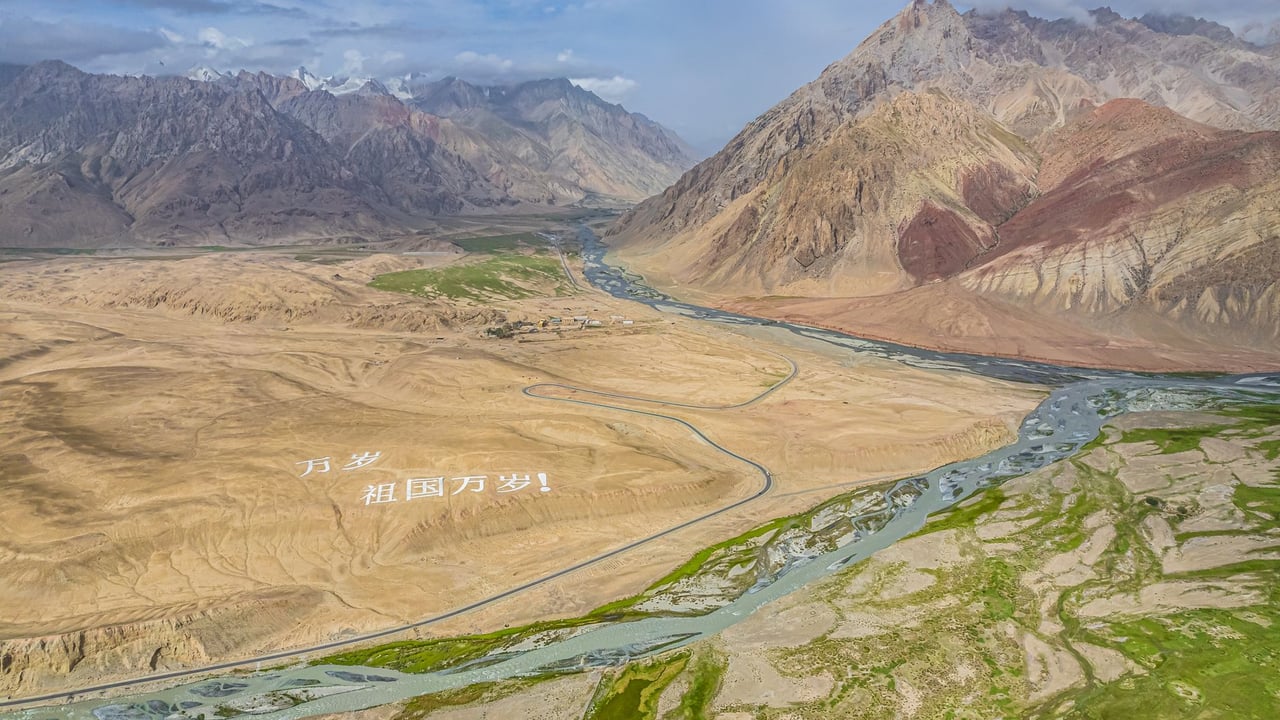

High on the wind-swept plateaus of the Xinjiang Military District, where oxygen is scarce and temperatures rarely rise above freezing, the Chinese People’s Liberation Army (PLA) has turned the landscape into a canvas of political loyalty. At the Qiudijianela outpost, situated over 5,000 meters above sea level, a massive hammer and sickle painted onto a cliff face—known as the 'Party Flag Mountain'—serves as a literal and figurative beacon for the troops stationed there. This is not merely a border post; it is a high-altitude theater of ideological commitment designed to steel the resolve of those guarding China's most sensitive frontiers.
The presence of these troops in the Ali (Ngari) region, often called the 'Roof of the World’s Roof,' dates back to 1950 when the PLA first entered Tibet to establish a permanent military presence. For the Central Military Commission in Beijing, these remote outposts represent the ultimate test of 'Party spirit' (dangxing). By framing border defense as a sacred duty to the Communist Party rather than just the state, the Chinese leadership reinforces a model where political reliability is the cornerstone of military effectiveness and territorial integrity.
Intergenerational continuity plays a vital role in the narrative surrounding these border units. Soldiers such as Li Xiaobin, the grandson of a member of the original 1950 advance company, are presented as living proof of the 'red gene' (hongse jiyin). This focus on lineage serves to legitimize current territorial stances by anchoring them in revolutionary history. It portrays the occupation and defense of the Himalayan plateaus as an unbroken chain of sacrifice that younger generations are expected to honor with similar stoicism.
Operational life at the Spanggur and Chipuqi outposts is defined by extreme physical hardship, from '69 hairpin turns' on supply routes to severe oxygen deprivation. High-profile reports of soldiers enduring blizzards and near-death experiences during patrols are used to emphasize that 'not an inch of territory will be lost.' This rhetoric has gained renewed weight in the wake of regional border tensions, reflecting a military culture that is increasingly dug-in, both physically and ideologically, against any perceived external pressure.