
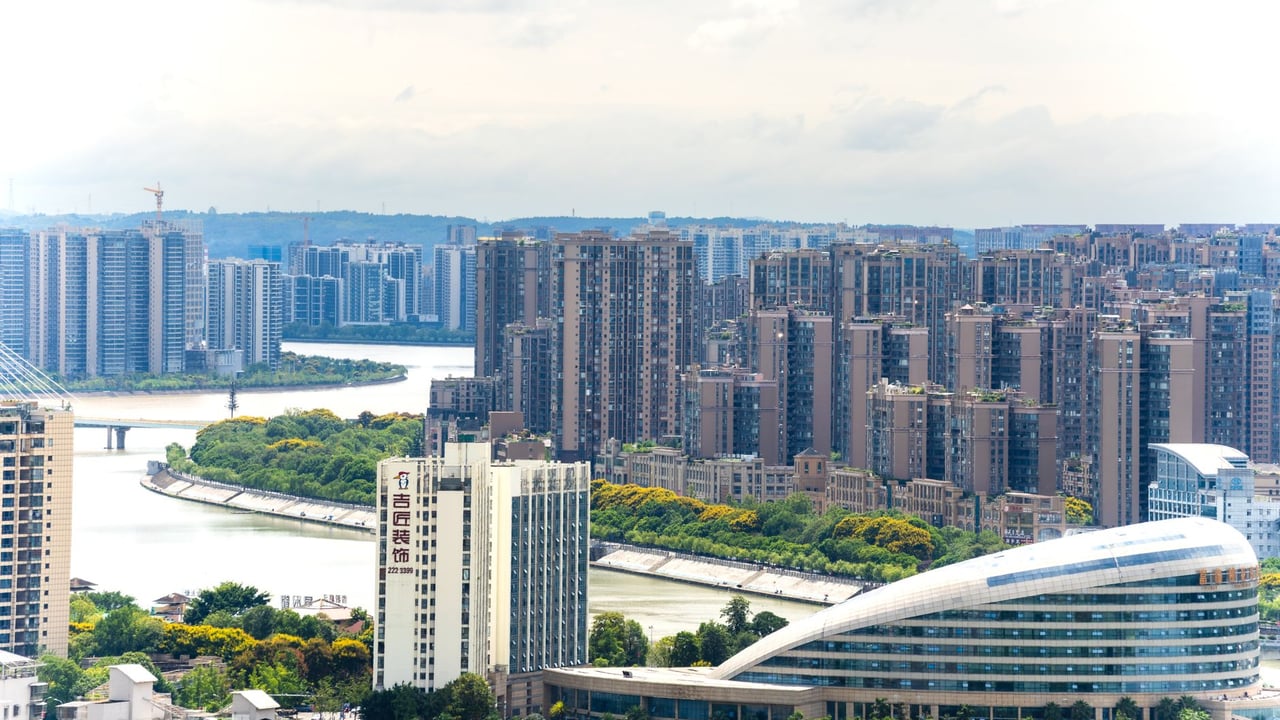

The first half of 2026 has exposed a starkly divided reality in China’s property sector, a phenomenon market observers are calling a 'K-shaped' divergence. While the broader national market continues to cool, with land transaction volumes and revenues falling by double digits, a localized 'Land King' fever has gripped the country’s most prestigious urban districts. At least 14 districts across 36 major cities have set new records for land prices per unit, creating an island of heat in an otherwise chilly economic climate.
In Shenzhen, the trend reached a fever pitch in June when a residential plot in the Nanshan district fetched 5.77 billion yuan ($793 million) after nearly 300 rounds of bidding. The resulting price per square meter shattered the city's previous historical record by nearly 30%, signaling that for the right location, capital is still willing to flow aggressively. Similar records were broken in the luxury lakeside districts of Suzhou and the riverfronts of Hangzhou, where developers fought over scarce, low-density plots that promise high returns in the premium residential segment.
This resurgence of high-priced bidding is not a signal of a general market recovery, but rather a strategic retreat to 'certainty assets.' Unlike the speculative frenzies of the last decade, today’s developers—primarily state-owned enterprises (SOEs)—are avoiding large-scale projects in favor of small, high-quality plots in established neighborhoods. These 'jewel box' developments are easier to sell and carry lower inventory risks, making them the only viable play for companies looking to preserve capital in a volatile environment.
Beyond these headlines, the macro picture remains sobering. Nationwide, the supply and transaction volume of residential land both fell by over 20% compared to the previous year, while total land revenue plummeted by 31.4%. Local governments are increasingly practicing 'quality over quantity,' drastically cutting land supply in saturated suburbs and secondary cities to prevent further price erosion. This controlled contraction is part of a broader national strategy to digest existing housing stock and stabilize prices at the cost of total volume.
The profile of the buyers further underscores the market’s structural shift. State-owned firms and central enterprises now account for 54% of all land purchases in major cities, while the role of local government financing vehicles (LGFVs) as a backstop has begun to fade. Private developers, once the primary engine of China’s urban growth, remain largely on the sidelines, representing only 17% of transactions as they continue to prioritize debt restructuring over new expansion.
Looking ahead, the 'ice and fire' dichotomy is likely to define the Chinese property landscape for the foreseeable future. While tier-one cities like Beijing, Shanghai, and Shenzhen can still generate bidding wars for their most coveted blocks, the vast majority of China’s secondary and tertiary cities face a 'frozen' land market. For local governments reliant on land sales to fund their budgets, this concentration of capital at the top of the urban hierarchy presents a significant long-term fiscal challenge.