
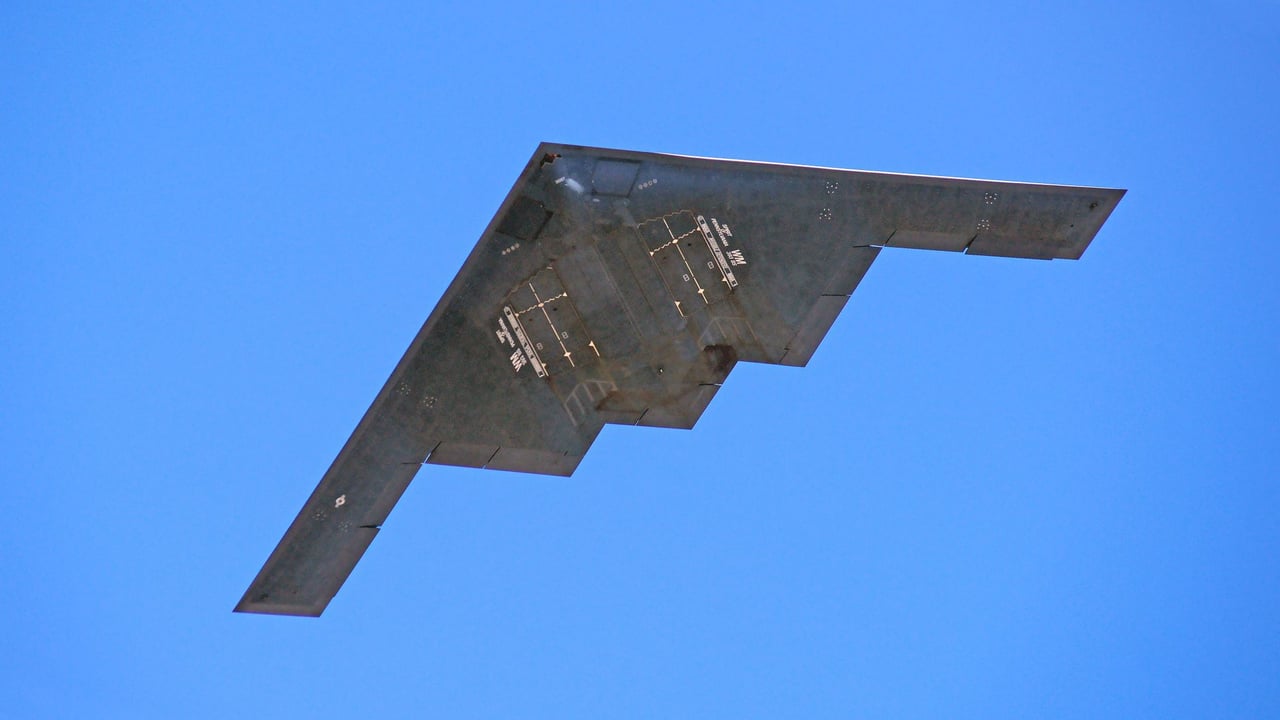

The strategic landscape of the Indo-Pacific has shifted following the recent disclosure of a potent new American tactical combination. During the Valiant Shield 2026 exercises near Guam, the U.S. Pacific Air Forces demonstrated a B-2 ‘Spirit’ stealth bomber live-firing an AGM-158C Long Range Anti-Ship Missile (LRASM). This previously classified capability represents a significant escalation in the Pentagon's ability to hold blue-water naval formations at risk.
This 'double stealth' doctrine pairs an ultra-low-observable platform with a passively guided, stealthy munition. Unlike legacy bombers like the B-52 or B-1B, which are easily detected by long-range radar, the B-2 can penetrate deep into contested airspace. By launching missiles from within 300 nautical miles, it compresses the defender's reaction window from hours to mere minutes.
The AGM-158C is particularly lethal because it eschews active radar during its terminal phase, relying instead on an infrared imaging seeker and an internal database of ship signatures. This allows the missile to ignore traditional electronic jamming and chaff while targeting the most vulnerable sections of a warship. For a Chinese carrier strike group, this means facing a threat that remains invisible until it breaks the horizon.
While the F-35 is often touted as the future of naval aviation, it lacks the internal bay capacity to carry the bulky LRASM without compromising its stealth profile. The B-2, acting as a 'stealthy truck,' can carry 16 of these missiles internally, maintaining its ghost-like signature throughout the mission. A small flight of four B-2s can saturate a fleet’s defenses with 64 missiles arriving simultaneously from multiple vectors.
Beijing is responding by evolving its defensive philosophy from ship-centric protection to 'system-of-systems' warfare. Chinese analysts argue that the U.S. 'kill web' is highly dependent on space-based reconnaissance and high-altitude drones. By targeting these sensors and disrupting the data links required for mid-course guidance, the People’s Liberation Army Navy (PLAN) aims to blind the invisible shooters before they can fire.
Furthermore, the PLAN is accelerating the deployment of the KJ-600 carrier-based early warning aircraft to extend its sensor horizon. These airborne platforms are essential for detecting high-altitude stealth bombers before they reach their launch points. The ongoing competition in the Pacific is no longer just about the number of hulls in the water, but about the invisible battle for electromagnetic and information dominance.