
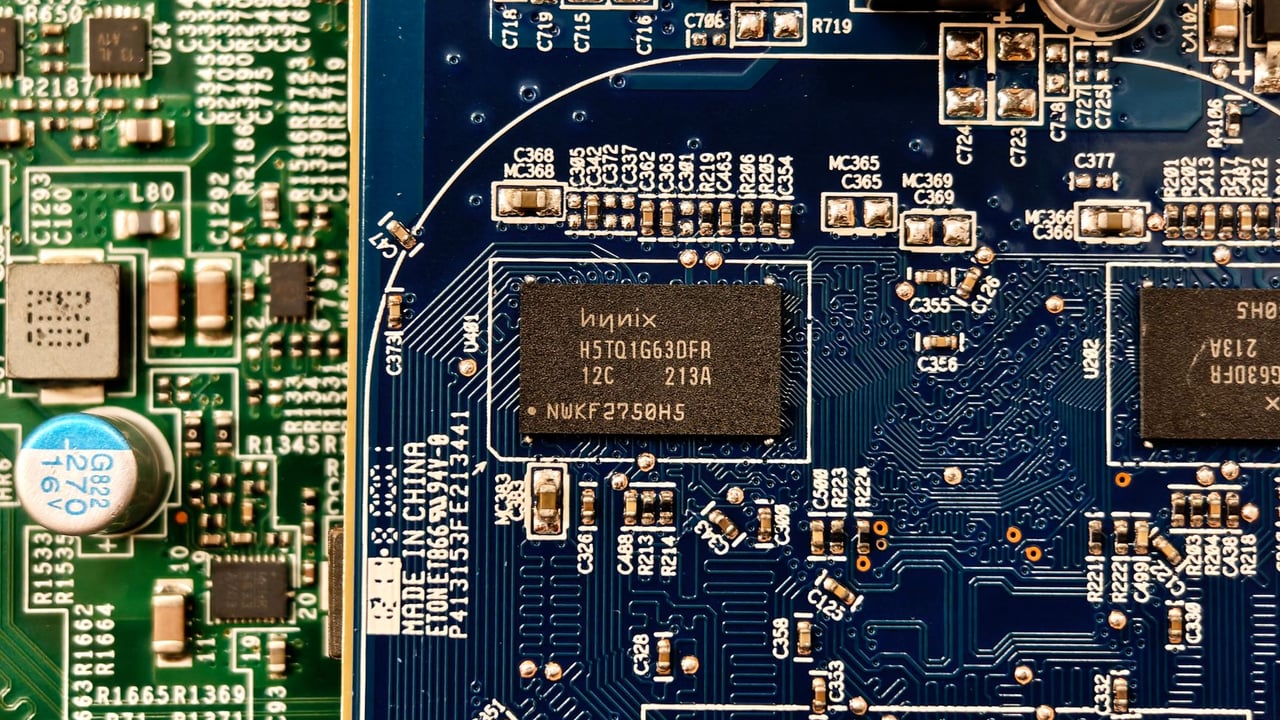

The global AI frenzy reached a new milestone as South Korean memory giant SK Hynix made a historic debut on the Nasdaq. Listing its American Depositary Receipts (ADRs) at an initial price of $149, the stock surged nearly 13% to close at $168.01, propelling the company’s market valuation to a staggering $1.2 trillion. The offering raised approximately $26.5 billion, officially surpassing Alibaba’s 2014 debut to become the largest US listing by a foreign entity in history.
While the sheer scale of the capital raised is a feat in itself, the event signifies a fundamental shift in how Wall Street values the artificial intelligence ecosystem. For years, the spotlight remained firmly on GPU designers like Nvidia and model builders like OpenAI. However, the Hynix listing proves that the investment community is now looking deeper into the stack, recognizing that high-performance compute is impossible without the specialized High Bandwidth Memory (HBM) that SK Hynix currently dominates.
Financial performance reflects this strategic importance. With the United States accounting for nearly 70% of its revenue, SK Hynix is no longer viewed as a cyclical commodity chipmaker but as a critical infrastructure provider for the AI age. Projected revenues for 2025 are nearing $65 billion, with net profits expected to double. By listing in New York, the company has successfully integrated itself into the 'AI asset narrative,' positioning its stock alongside industry titans like TSMC and Broadcom.
Despite the exuberant debut, the market is showing signs of sophisticated selectivity. While SK Hynix basked in a sevenfold institutional oversubscription, peers like Micron and Western Digital saw their shares soften on the same day. This divergence suggests that investors are no longer buying the 'chip sector' as a monolith, but are instead placing specific bets on the firms that sit at the tightest bottlenecks of supply, specifically in the HBM3E and next-generation packaging segments.
To cement this lead, SK Hynix is moving aggressively to localize its footprint within the US and its home base. Plans are already underway for a sophisticated packaging and R&D facility in Indiana, complemented by a massive $518 billion investment roadmap in South Korea’s semiconductor hubs. The company’s long-term challenge will be transforming this current supply squeeze into a durable, multi-decade cash flow engine that can survive the inevitable volatility of the tech cycle.