
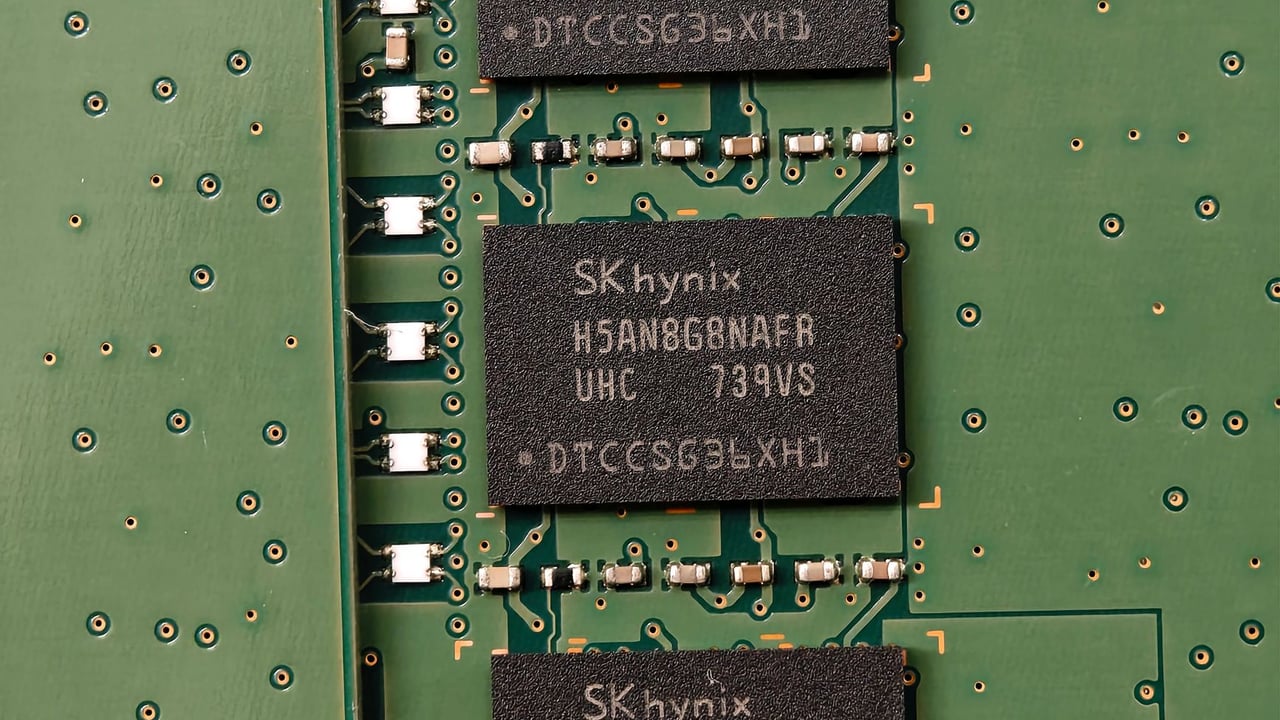

On the day of its landmark debut on the Nasdaq, South Korean memory giant SK Hynix has issued a stark warning to the global technology sector: the world is entering a period of structural scarcity for memory chips that could last at least a decade. Chief Executive Kwak Noh-jung stated that the industry is barreling toward its most severe supply-demand imbalance yet, with 2027 projected to be the ‘tightest year in history’ for memory availability.
This forecast arrives as the demand for High Bandwidth Memory (HBM)—the critical hardware that allows Nvidia’s AI processors to handle massive datasets—continues to outstrip production capacity. While SK Hynix has established itself as the premier supplier for the AI revolution, Kwak emphasized that even with aggressive expansion, the firm expects demand to outpace supply well into the 2030s. The company’s stock reflected this bullish outlook, surging nearly 13% on its first day of trading in New York, bringing its market valuation to a staggering $1.22 trillion.
Beyond production warnings, SK Hynix is currently navigating a complex geopolitical map as it selects the site for its next major wafer fabrication plant. Kwak identified the United States, Japan, and Southeast Asia as the primary candidates, noting that the final decision will hinge on the availability of power, water, skilled labor, and competitive manufacturing costs. The company has already committed $4 billion to a packaging facility in Indiana and another $10 billion toward an AI solutions subsidiary in the U.S., signaling a deep strategic pivot toward the American market.
While some investors fear that the AI investment cycle may be nearing a peak, industry heavyweights remain resolute. Nvidia CEO Jensen Huang has echoed Kwak’s sentiments, suggesting that the HBM shortage will persist for several years as SK Hynix remains their primary partner. Supporting this view, analysts from UBS and Bank of America point to the rising capital expenditures of ‘hyperscalers’—the massive cloud providers like Meta and Google—as evidence that the infrastructure build-out for compute-intensive AI applications is only just beginning.