
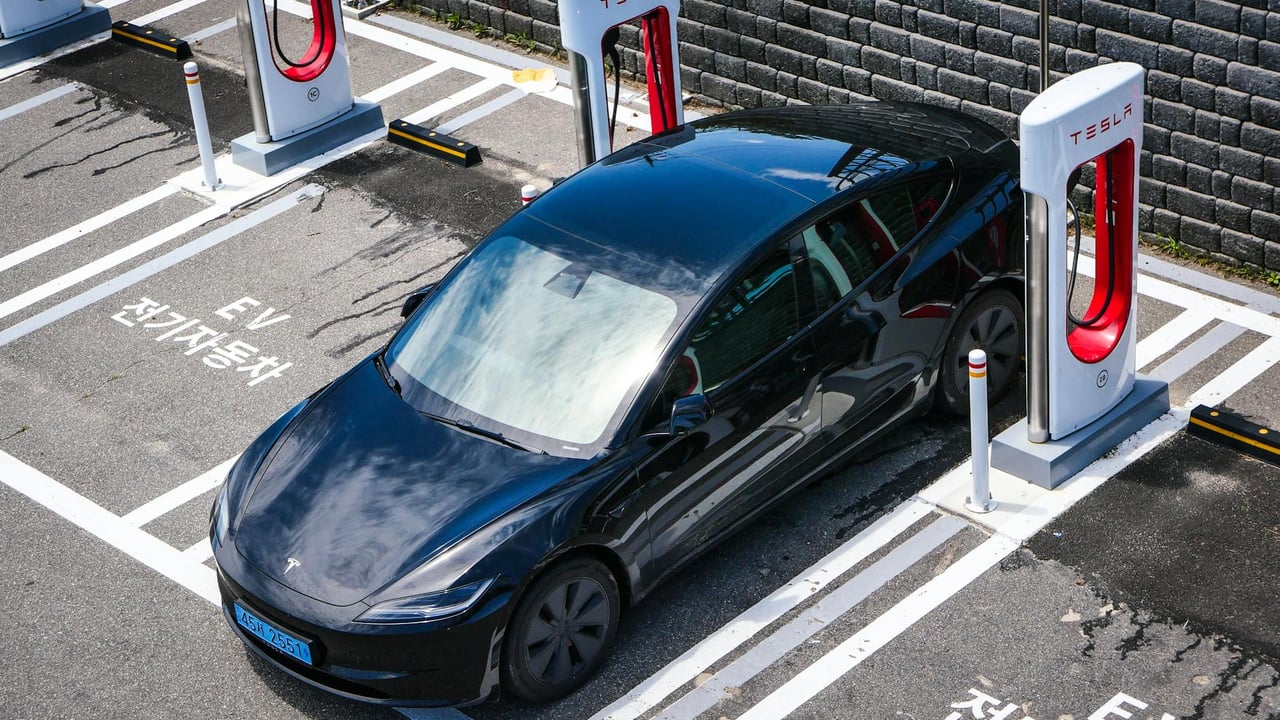

Tesla closed 2025 with a paradox. Its core car business faltered: deliveries fell to 1.636 million vehicles, a second consecutive annual decline, and automotive revenue slipped about 10% to $69.5bn. Margins have been compressed by a global price war and the loss of regulatory credit revenue, leaving automotive gross margin (ex-credits) at 15.4% for the year and single-car gross profit down to the low thousands of dollars.
Elon Musk has responded by slimming the product line and shifting the company’s narrative. Model S and Model X will cease production after Q1 2026, and management has poured capital into AI and autonomy — building a Cortex 2 supercomputer in Texas and developing successive in‑house chips — while pitching Robotaxi, FSD subscriptions and the Optimus humanoid as the growth engines of the future. Investors bought the story: Tesla’s share price recovered from a low of $221 to trade above $400 and at times near $495, restoring a market capitalisation of roughly $1.4 trillion despite the deteriorating auto fundamentals.
Under the hood, the pain in the vehicle business is structural. China and Europe — once engines of growth — turned cold: Tesla has slipped to fifth place in China and ceded the global EV crown to BYD, whose pure‑electric volume reached about 2.257 million units in 2025. In Europe Tesla’s volumes fell 27% year on year, prompting production cuts and layoffs at Berlin. The company’s product cadence has lagged competitors: Model 3 and Model Y updates have been sporadic, leaving rivals to exploit a fast‑moving market with fresher designs and value propositions.
A second, subtler shift is underway inside Tesla’s income statement. Regulatory credit sales, long a quiet profit source, have been curtailed by rule changes — a stream that ended in 2025 — and the firm’s automotive margin share in total gross profit has collapsed from over 80% in prior years to under half. Operational costs have climbed as Tesla funds its AI ambitions: operating expenses jumped 23% to $12.74bn, and R&D and infrastructure spending on chips and supercomputers is a sustained cash burn.
Yet Tesla is not cash‑starved. Free cash flow rose to $6.22bn in 2025 and the company finished the year with roughly $44.1bn in cash and investments. That balance sheet flexibility is why management can afford the strategic pivot and why investors appear willing to price future optionality into today’s equity.
The business most likely to bridge Tesla’s present and promised futures is energy storage. Storage revenue hit $12.77bn in 2025, up 27%, with deployed capacity rising to a record 46.7 GWh. Crucially, storage delivered outsized profitability: Q4 storage gross margin reached 28.7%, and the segment — roughly 13% of revenue — contributed nearly a quarter of company profits. Megapack utility projects and Powerwall home systems sell as integrated energy solutions, where vertical integration and engineering scale create higher pricing power than the cut‑throat vehicle market.
Autonomy remains the poster child for Tesla’s upside, but its path to material revenue is uncertain. FSD subscriptions rose to about 1.1 million active users after price cuts and a switch to subscription‑only monetisation, representing only about 12% penetration of Tesla’s installed base. Regulatory barriers in Europe and China limit near‑term scaling, and the unit economics of subscriptions are unlikely to fill the revenue hole left by vehicle sales in the near term.
Robotaxi and Optimus embody the company’s longer‑dated, higher‑value convictions. Tesla operates Robotaxi pilots in Austin and the San Francisco Bay Area and plans to expand to seven additional U.S. cities in the first half of 2026 while starting Cybercab production in April–May 2026. Optimus remains early: a third‑generation prototype is scheduled for Q1 2026 with potential commercial sales in late 2027, but production risks are acute; sourcing and integrating thousands of unique components for a humanoid will be costly and time consuming.
The market has effectively re‑rated Tesla from an auto manufacturer to an AI and energy play. Analysts such as Morgan Stanley have modelled much of the firm’s equity value on non‑automotive optionality, assigning only a small portion of the share price to the core vehicle business. That thesis will be tested in 2026: Robotaxi roll‑outs, Cybercab ramp timing, Optimus milestones, and whether storage can sustain double‑digit growth will determine if the valuation premium was prudent speculation or expensive faith.