
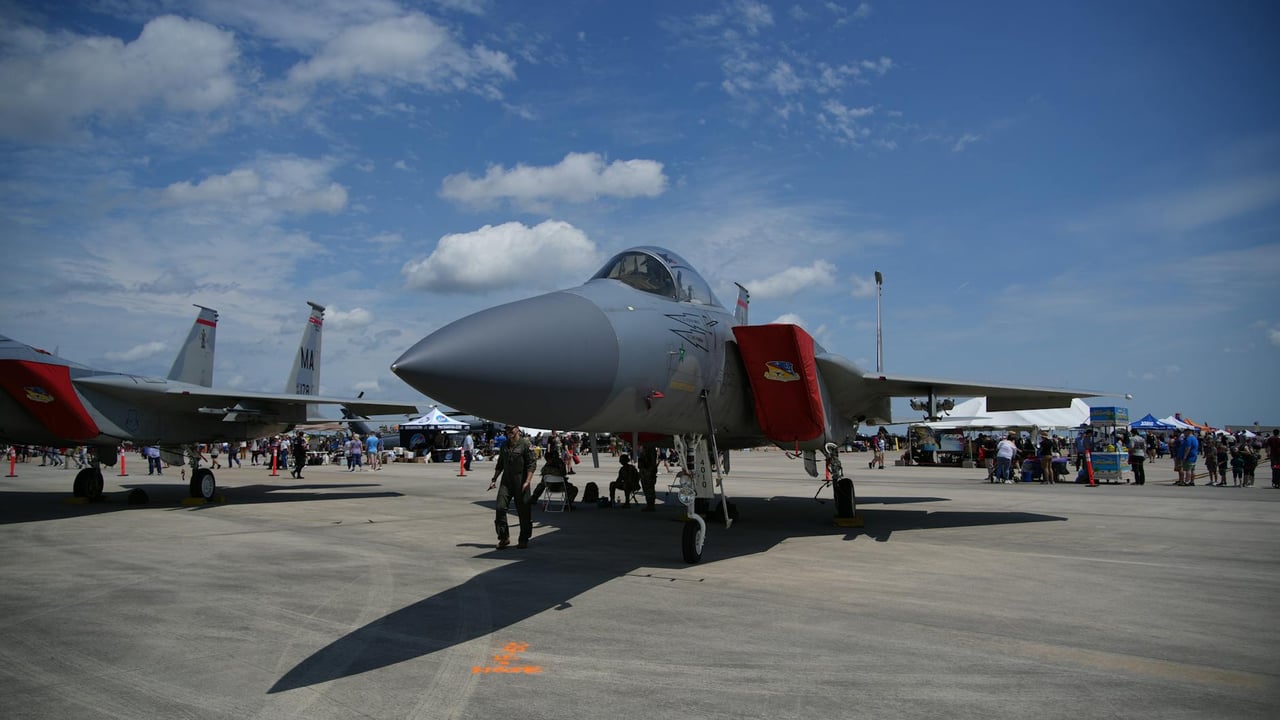

Satellite imagery captured on February 26 shows 11 U.S. F-22 Raptor stealth fighters deployed to Ovda Airbase in southern Israel, underscoring Washington’s recent surge of advanced military assets into the Middle East. The arrival, confirmed by open-source satellite imagery, is part of a broader U.S. deployment to the region and represents one of the more visible uses of fifth‑generation U.S. combat aircraft outside routine basing patterns.
The F-22 is a purpose-built air-superiority platform with stealth, sensor fusion and high-performance capabilities that make it particularly valuable for controlling airspace and denying rivals freedom of action. While the U.S. operates other stealth types in the region, the forward presence of F-22s is relatively infrequent and therefore carries distinct operational and political weight.
For Israel, hosting the Raptors enhances immediate air‑defense and strike coordination options with a close ally, complicating calculations for Iran and its proxy groups. The deployment signals Washington’s intent to reassure a key partner and to deter adversaries by placing one of its most capable air combat assets within easy reach of potential flashpoints.
Beyond the hardware, the movement requires a substantial logistical and support footprint — tankers, maintenance crews and command-and-control links — which highlights the depth of U.S. military commitment while also exposing the limits of sustaining a high-end presence far from home bases. The posture amplifies surveillance, rapid-reaction and interoperability possibilities, but it also increases the risk of miscalculation in a crowded and volatile battlespace.
The visible arrival of F-22s serves a double strategic function: deterrence and messaging. For regional states and non-state actors, it demonstrates Washington’s willingness to escalate the quality — not just the quantity — of its forces in defence of partners. For international audiences, it is a reminder that advanced U.S. platforms are being used not only in great‑power competition scenarios but also as stabilizing (and potentially destabilizing) instruments in regional conflicts.
How long the Raptors remain in Israel will depend on evolving security dynamics, political calculations in Washington and Tel Aviv, and operational constraints. In the short term, the deployment strengthens allied deterrence; over the medium term, it may prompt counter‑responses from rivals and further entrench a pattern of high-end force deployments in the Middle East.