
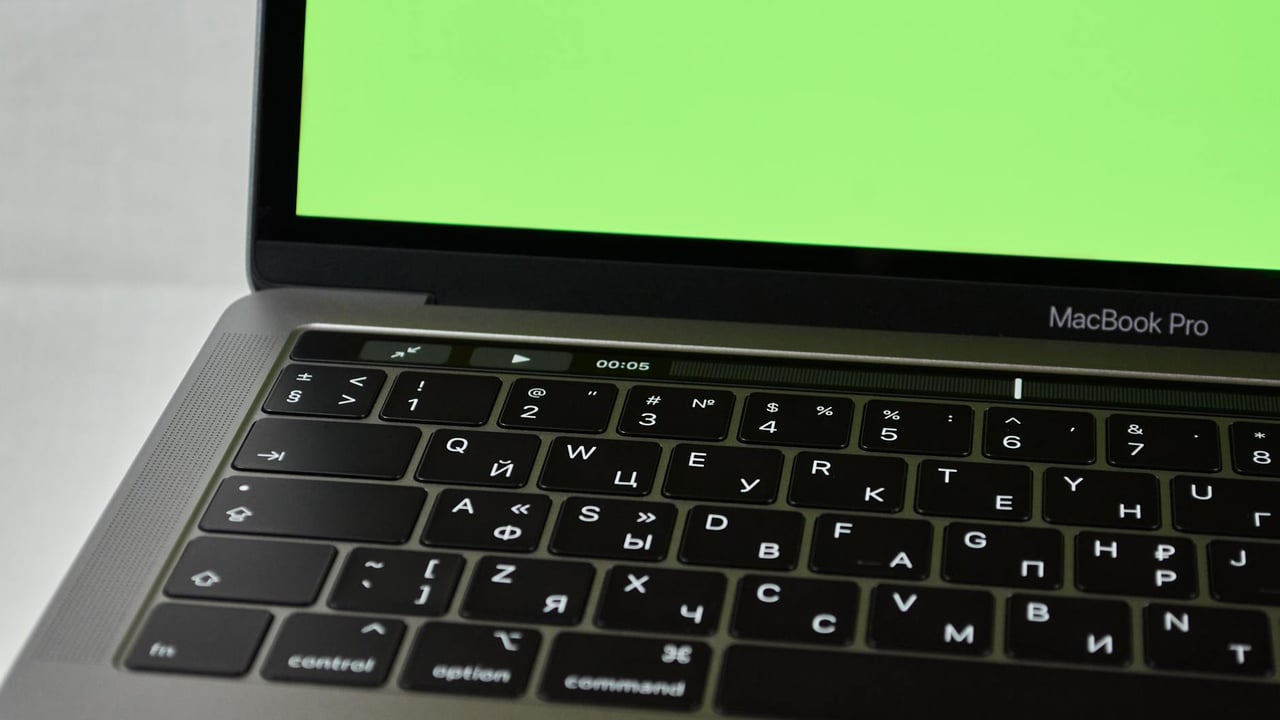

Apple is preparing a cluster of product launches this week, but a milestone product — a touchscreen MacBook Pro — will not appear at the March event, according to reporting by Mark Gurman. Apple executives remain committed to keeping Mac and iPad as separate product lines, even as engineers explore hybrid ideas; the first MacBook Pro with an OLED touchscreen is now expected to ship toward the end of 2026.
The touchscreen MacBook Pro is described as an evolutionary rather than revolutionary step: it will adopt a Samsung-supplied, row-driven OLED touchscreen across 14-inch and 16-inch models, introduce a smaller cutout inspired by the iPhone’s Dynamic Island, and let users switch fluidly between touch and click thanks to recent interface work Apple calls a “liquid glass” update. Crucially, Apple will keep a full keyboard and large trackpad; the machine is “touch-friendly” rather than “touch-first,” preserving macOS’s point-and-click interaction model and differentiating it from iPad’s touch-centric iPadOS experience.
Underpinning the hardware upgrades, the touch MacBook Pro is expected to be the first Mac to ship with TSMC’s 2nm M6-series chips. Apple’s roadmap reportedly includes an M6 Max variant promising roughly a 30% CPU uplift, 40% faster GPU, and a doubling of AI compute versus the previous generation. Those gains would keep Apple competitive against high-end x86 laptops and make the MacBook Pro more attractive to creators and professionals who prize both battery life and performance.
Apple’s corporate logic for separating Mac and iPad is partly commercial. Gurman notes that the two product lines are each worth roughly $30 billion a year in revenue, and that they contributed about $61.7 billion combined last year — a non-trivial slice of Apple’s business. Executives prefer positioning the devices as complementary “partners” rather than substitutes, preserving product identity, margins and predictable upgrade cycles across both ecosystems.
Beyond the touchscreen MacBook Pro, Apple is actively developing other form factors: a large, foldable iPad with a Mac-class display size is said to run pure iPadOS and follow iPad design principles, not macOS. That device would extend Apple’s iPad roadmap without dissolving the boundary between tablet and laptop experiences. In the near term, Apple’s March 4 event is still expected to bring a suite of updates — including new MacBook Air and MacBook Pro refreshes, an updated entry-level iPad and iPad Air, a low-cost MacBook using A-series silicon, and possibly the iPhone 17e — while retail teams brace for a surge in store traffic.
The technical and supply-chain choices behind these devices are consequential. Selecting Samsung’s custom OLED panel underscores Apple’s dependence on South Korean display suppliers for cutting-edge laptop panels, and the move to TSMC’s 2nm node ties performance progress to Taiwan’s chip-making capacity. Both choices have geopolitical and manufacturing implications: high-volume OLED yield curves and 2nm ramp schedules will shape when Apple can scale production and how it prices these new models.
For consumers and developers, a touch-capable MacBook Pro raises questions about software. Apple has so far resisted making macOS touch-first; shipping a touch-capable laptop without changing the fundamental interaction model signals a deliberate middle path. Developers may face pressure to make macOS apps more touch-friendly, while Apple’s insistence on preserving distinct OS philosophies reduces the risk of feature cannibalization between Mac and iPad.
In short, the touchscreen MacBook Pro — important in symbolic and practical terms — will be an incremental but meaningful expansion of the Mac line, aimed at broadening input options without erasing product boundaries. Its delay to late 2026 means Apple will phase in the hardware, software and supply-chain adjustments on a timescale that prioritizes stability, yields and the commercial health of two cornerstone product families.