
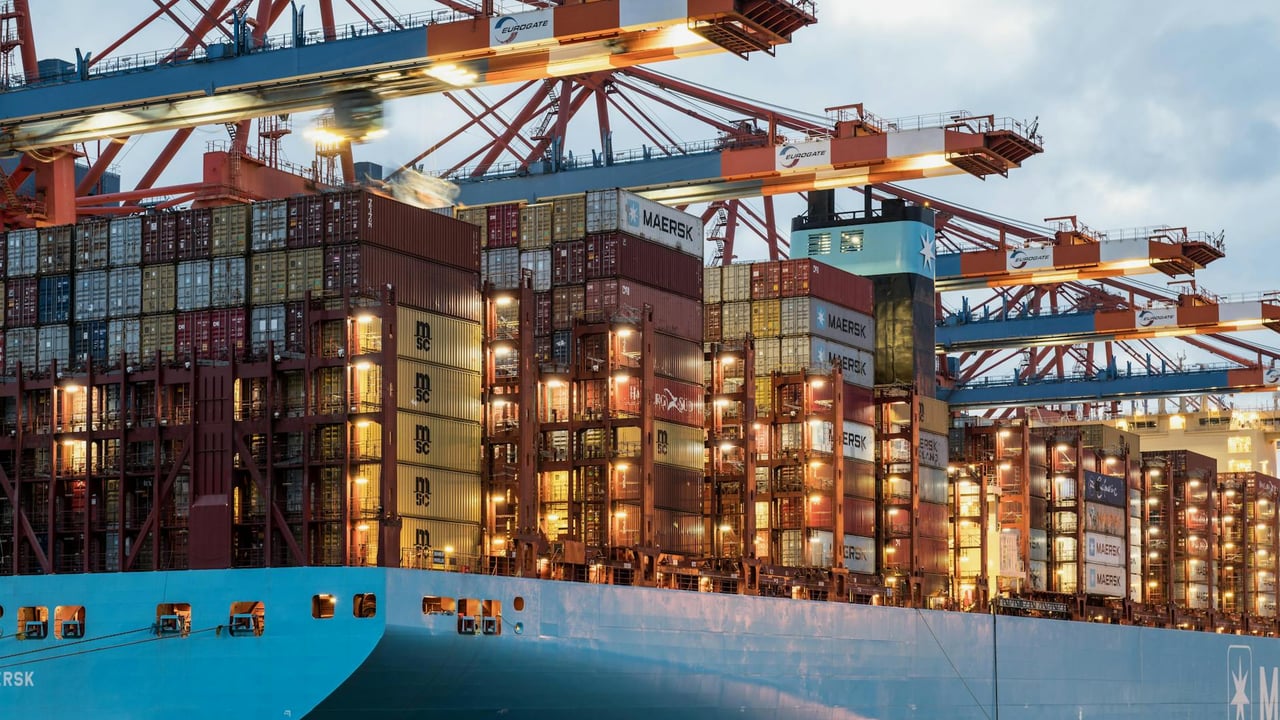

China has quietly summoned senior executives from Maersk and Mediterranean Shipping Company (MSC) in Beijing, signaling mounting impatience with how global carriers have reacted to the Middle East security shock. Officials from the transport ministry and the National Development and Reform Commission raised explicit concerns about sudden route suspensions, steep emergency surcharges and the knock‑on risk to China’s trade flows.
The meetings followed moves by carriers to suspend or scale back voyages to Persian Gulf ports after Iranian threats and limited blockades of the Strait of Hormuz, and to levy emergency fees for rerouting and storage. Maersk announced steep emergency surcharges — up to $1,800 for a 20ft box and $3,000 for a 40ft box — while MSC raised fuel surcharges and spot rates on major lanes, prompting Beijing to frame the behavior as a threat to supply‑chain stability.
Beijing’s approach was terse but demonstrative: a short public statement confirming the meetings and private representations to the companies. China’s practice of “regulatory interviews” is seldom merely conversational; it is a calibrated tool that can precede administrative pressure or regulatory friction if state concerns are not quelled.
The backdrop is a congested and geopolitically fraught maritime environment. Beyond the Gulf, a separate dispute over Panama’s takeover of two ports previously run by Hong Kong’s CK Hutchison has added fuel to Beijing’s grievances; temporary concessions to APM Terminals (Maersk) and Panama TIL (MSC) prompted Chinese actors to label the carriers as complicit in the “expropriation” of Chinese assets.
Chinese trade with the Middle East has been expanding rapidly, making uninterrupted access to Gulf and Panama corridors economically significant. Customs figures show exports to the Middle East surging in recent months, and the Panama Canal remains vital for moving soy, ores and other bulk commodities into China. Disruption or perceived discrimination against Chinese cargo would therefore have swift economic consequences.
Shipping analysts warn that while carriers may face political heat, their commercial calculus is complex. Maersk and MSC operate globally and rely on predictable access to markets and terminals everywhere; overtly discriminating against Chinese cargo would damage their own networks and invite reciprocal actions. At the same time, Beijing has a range of levers short of outright bans — from port access and terminal contracts to customs facilitation and spot‑market favour — which could be deployed selectively.
Legal and diplomatic battles are already unfolding. Hutchison has initiated arbitration under ICC rules seeking at least $2 billion over Panama’s port actions, and Beijing’s foreign‑ministry spokespeople have publicly pledged to defend the rights of Chinese enterprises. The interplay between courts, arbitration, state diplomacy and administrative measures will determine whether this episode is a brief regulatory warning or the start of a broader commercial squeeze.
For global shippers and their customers, the lesson is stark: geopolitical shocks in one region can quickly cascade into commercial policy responses in another. Firms that moved to protect short‑term margins by rerouting or surcharging now confront a state keen to defend national trade resilience and reputations, raising the prospect of a more politicised operating environment for maritime logistics.