
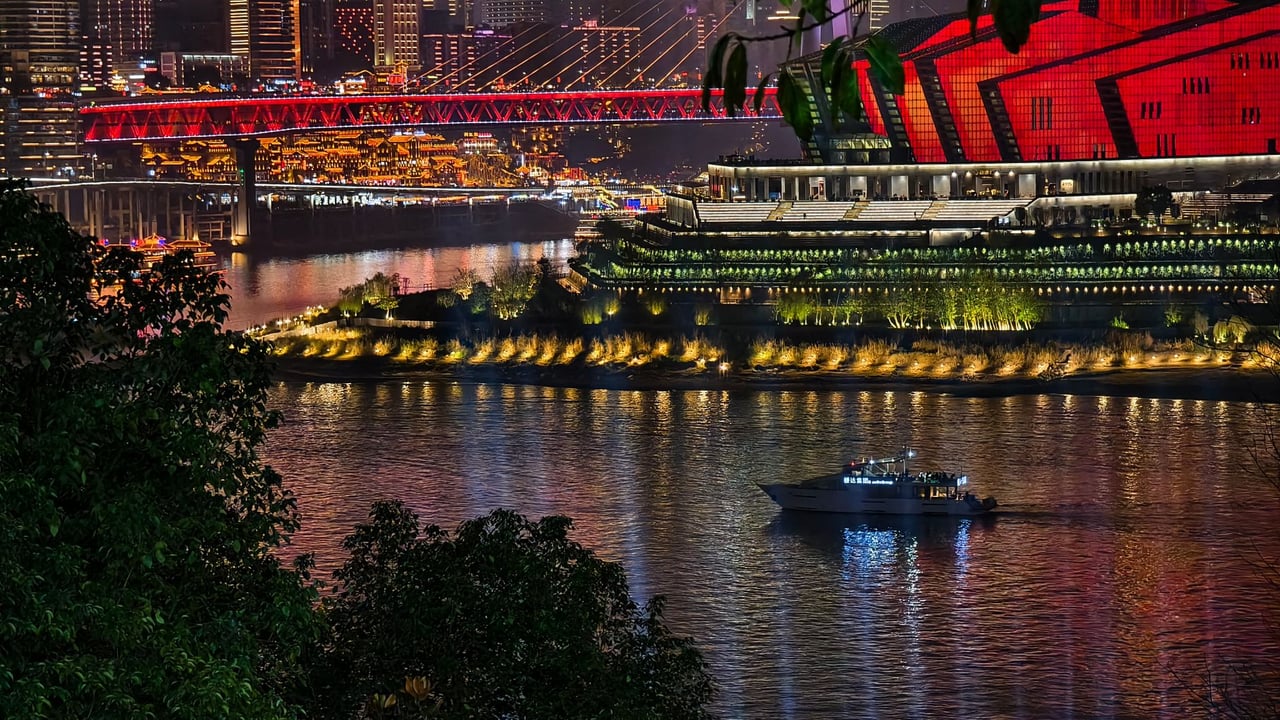

As night falls beneath the Dongshuimen Bridge in Chongqing, the roar of motorcycle engines competes with the rhythmic pulse of neon lights. Tourists queue for a specific shot: arms outstretched on the back of a bike, the city’s ‘cyberpunk’ skyline shimmering across the Yangtze. This is Chongqing’s ‘Visa on Arrival’—not a legal entry document, but a viral photography package that has become the essential passport for any visitor claiming to have experienced China’s most vertical metropolis.
Originally a grassroots trend on domestic platforms like Douyin, where the hashtag has garnered over 1.1 billion views, the phenomenon has successfully jumped the ‘Great Firewall.’ On TikTok, international influencers are adopting the Chinese term ‘Visa on Arrival’ to describe their own experiences. The trend is driving a tangible surge in physical arrivals; in the first half of 2026, Chongqing reported over 610,000 international tourist entries, an 86% year-on-year increase that signals a robust recovery for inbound travel.
The genius of the trend lies in its low barrier to entry and high production value. For as little as 198 RMB (roughly $27), tourists receive a choreographed photoshoot and professionally edited short video. The city itself acts as an irreplaceable backdrop, offering an '8D' architectural maze of monorails piercing through buildings and golden bridges that feels more like a science-fiction set than a traditional tourist destination. This visual density creates a 'social media currency' that translates effortlessly across borders.
For international visitors, the appeal is often rooted in a surprising sense of security. In many global cities, hopping on a stranger’s motorcycle at night would be considered high-risk behavior. In Chongqing, the presence of localized safety protocols and visible, yet supportive, law enforcement has turned the experience into a testament to China’s urban safety. Foreign tourists are increasingly mixing traditional elements, such as wearing Hanfu robes while riding on high-powered motorbikes, creating a unique synthesis of ancient culture and ultra-modern grit.
Local authorities have opted for a sophisticated governance strategy rather than the heavy-handed bans seen in other municipalities. Chongqing has established dedicated 'safe filming zones' and deployed extra police during peak hours to manage traffic flow and prevent illegal vehicle modifications. By drawing a hard line on safety—issuing thousands of citations for speeding or stunt riding—while protecting the creative space for businesses, the city has successfully institutionalized a viral moment into a sustainable industry.
Chongqing is not alone in this shift toward 'ritualized' tourism. From 'hand-catching' planes in Xiamen to 'confessing' at police stations in Changsha, Chinese cities are moving away from traditional sightseeing toward interactive, performance-based experiences. In this new landscape, the tourist is no longer a passive observer but a protagonist in a digital narrative. For Chongqing, the challenge now lies in standardization, as the market grapples with inconsistent pricing and the pressure to keep the 'cyberpunk' fantasy alive without succumbing to commercial fatigue.