
Business & IndustryAnalysis
Xi'an-Ankang High-Speed Railway Opens, Cutting Travel Time to Under an Hour
The 171-kilometer mountain line completes the core north-south axis of Shaanxi's high-speed rail network.
Share
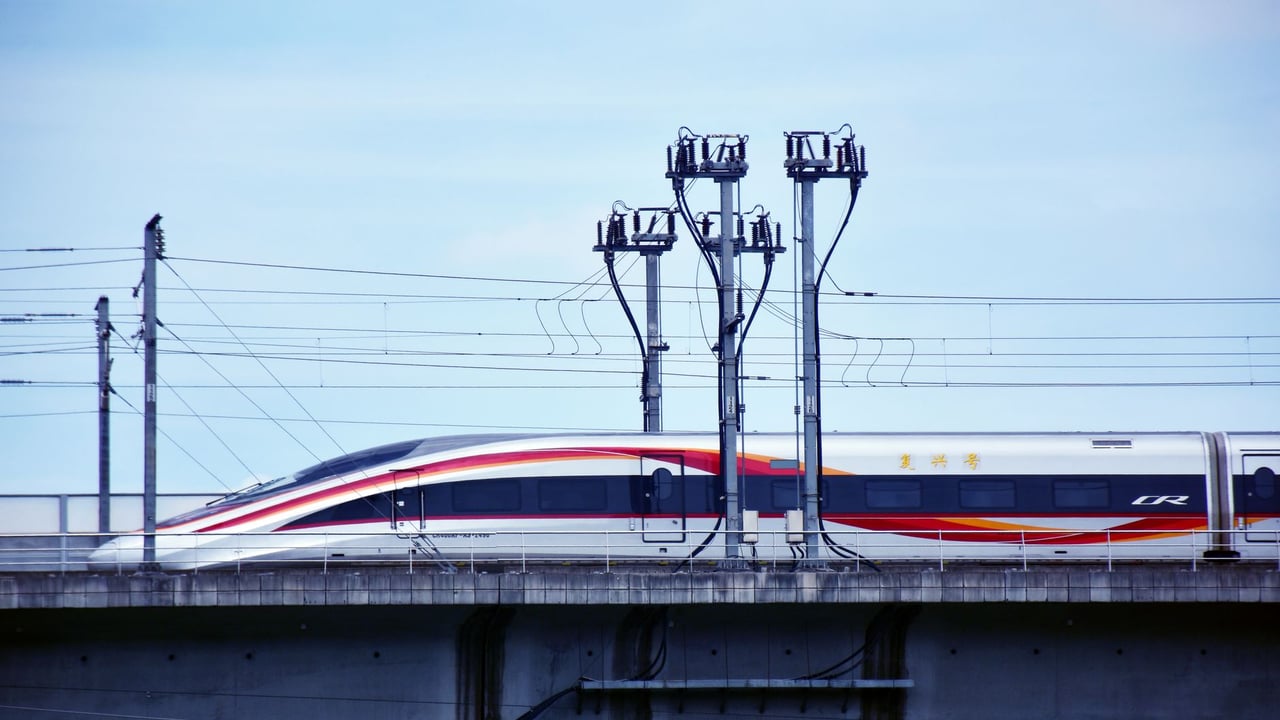
Photo by Raven Zhou on Pexels
The Brief
The high-speed railway connecting Xi'an and Ankang in Shaanxi province has officially commenced operations, significantly improving connectivity across the Qinling Mountains. The 171-kilometer line, designed for speeds of up to 350 kilometers per hour, cuts travel time between the provincial capital and southern Shaanxi from around three hours to under one hour. Featuring a 94.6 percent bridge-and-tunnel ratio, the project completes a critical vertical link in China's national high-speed grid and anchors Shaanxi's provincial rail network.
Why it matters
By drastically reducing travel times across the rugged Qinling mountain barrier, the new railway integrates the Qinba mountain region directly with the Guanzhong economic plain. The corridor improves domestic logistics and tourism access, supporting regional economic rebalancing and rural revitalization initiatives in southern Shaanxi while establishing a higher-capacity passenger route toward southwestern China.
China context
The line serves as an integral section of two trunk corridors in China's national 'Eight Vertical and Eight Horizontal' high-speed rail master plan: the Baotou (Yinchuan)–Haikou and Beijing–Kunming corridors. Domestically in Shaanxi, state planners have framed it as the final vertical stroke completing the province's star-shaped rail network hub centered on Xi'an.
Editor's View
EDITOR'S VIEW — Analysis and inference, not factual reporting.
The opening of the Xi'an-Ankang line highlights China's continued technical focus on completing challenging topological bottlenecks within its interior high-speed network. Beyond headline engineering metrics such as its 94.6 percent bridge-and-tunnel ratio, the line's long-term commercial return will depend on whether smaller municipalities along the route, such as Shangluo and Ankang, can convert faster passenger transit into sustained tourism spending and regional industrial integration rather than experiencing capital and talent drain toward Xi'an.
What to watch
- Initial passenger traffic volumes and seat occupancy rates during holiday travel periods.
- Municipal tourism consumption and hospitality sector uptake across Shangluo and Ankang.
- Construction milestones on planned southward extensions connecting Ankang toward Chongqing.
Key Takeaways
- 1The 171-kilometer Xi'an-Ankang high-speed line opened on September 28 with a design speed of 350 km/h.
- 2Travel time between Xi'an and Ankang has been reduced from roughly three hours to less than one hour.
- 3The line features a 94.6 percent bridge-and-tunnel ratio, the highest tunnel share among high-speed rail lines crossing the Qinling range.
- 4The route serves five stations across Xi'an, Shangluo, and Ankang, supporting regional transit and mountain tourism.
- 5The project forms part of two national rail corridors and completes the core vertical corridor of Shaanxi's provincial network.
Commercial operations officially began on the Xi'an-Ankang high-speed railway on the morning of September 28, marked by the departure of a Fuxing bullet train from Xi'an East Railway Station, according to Xinhua.
The newly commissioned line covers a total length of approximately 171 kilometers and is designed for operational speeds of up to 350 kilometers per hour. Traversing the three municipal jurisdictions of Xi'an, Shangluo, and Ankang, the line includes five passenger stations along its route. With the opening of the line, rail transit time between Xi'an and Ankang has dropped from approximately three hours to under one hour.
Traversing the rugged Qinling mountain range, the railway was constructed under severe geographical and ecological constraints. Bridges and tunnels account for 94.6 percent of the total line length, representing the highest proportion of tunnels among all high-speed rail lines crossing the Qinling Mountains to date, state media reported.
Zhang Ruitao, chief designer of the project at China Railway First Survey and Design Institute Group Co., Ltd., noted that the alignment faced major engineering hazards including rock bursts, unstable surrounding rock formations, and sudden water and mud incursions. Engineers addressed these risks through advanced geological forecasting, curtain grouting support, expansive soil stabilization techniques, and tiered rock-burst mitigation systems. Construction protocols were also designed to protect ecological red lines within the Qinling conservation zone.
In addition to local commuter and business travel, the line is expected to facilitate leisure travel into scenic areas along the Qinling-Bashan corridor, including Niubeiliang National Forest Park, Zhashui Karst Cave, and Mount Tayun. Regional operators anticipate an influx of tourism traffic into southern Shaanxi from the provincial capital.
Nationally, the Xi'an-Ankang railway constitutes a key component of both the Baotou (Yinchuan)–Haikou corridor and the Beijing–Kunming corridor under China's mid-to-long-term high-speed rail development program. Within Shaanxi, provincial transport planners view the route as the final vertical segment completing the province's hub-and-spoke rail network centered on Xi'an.
Sources
- 西康高铁正式开通运营 陕西“米”字形高铁网基本成型 — China News Service · 9/28/2026
- 西安至安康高铁开通 秦巴山区再添通衢--经济·科技--人民网 — People's Daily · 9/28/2026