
Business & IndustryAnalysis
Pinglu Canal Completes 104-Bridge Engineering Drive Ahead of Opening
The reconstruction of 27 cross-channel spans removes clearance bottlenecks for 5,000-tonne vessels ahead of scheduled navigation.
Share
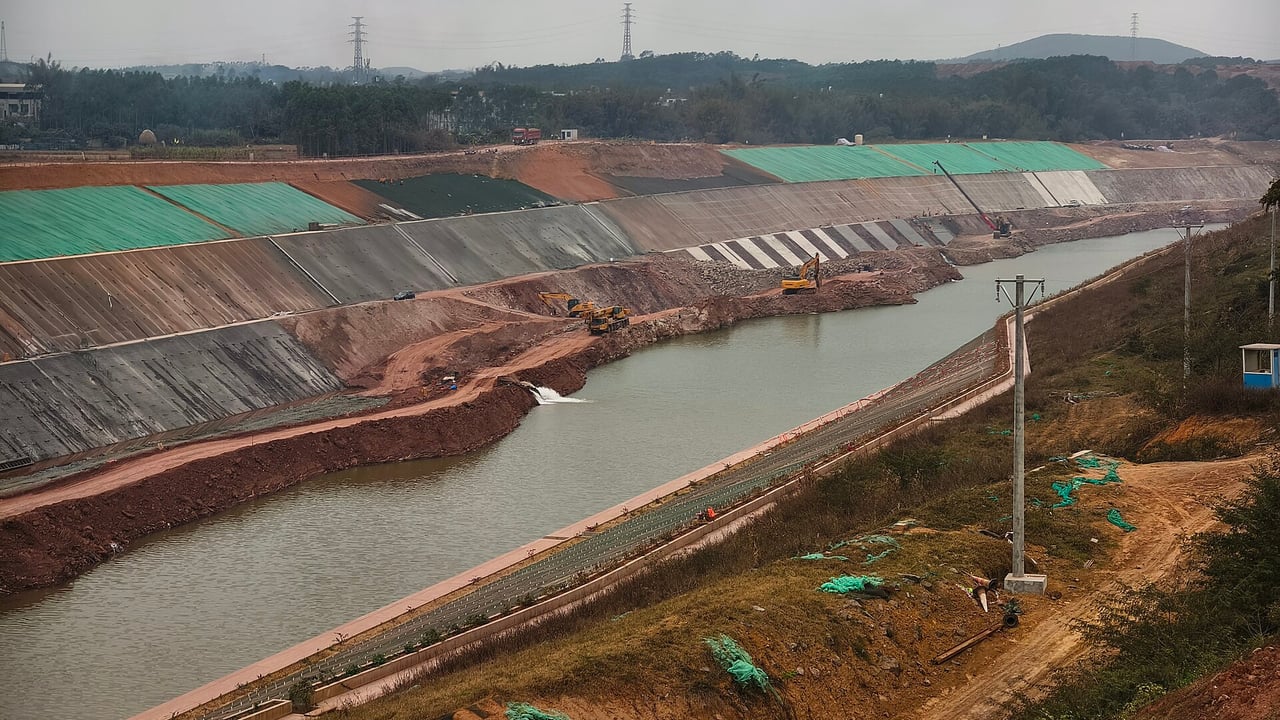
MspreilsCN via Wikimedia Commons, CC0
The Brief
The Pinglu Canal project in Guangxi has completed major bridge works across its route, covering 104 total bridges including 27 cross-channel spans, according to state media Xinhua. The bridge overhaul was necessary to clear navigation height restrictions for 5,000-tonne vessels before the canal's targeted opening on September 16, 2026. Key milestones included the reverse-demolition of the old Zicai Bridge, modular water-transport assembly for the Qinjiang Bridge, and a 16-hour integral lift on the G75 Lanzhou-Haikou Expressway bridge while maintaining partial expressway traffic.
Why it matters
Eliminating navigational clearance bottlenecks across 27 primary crossing bridges is the critical prerequisite for allowing 5,000-tonne sea-river vessels to transit the Pinglu Canal, unlocking direct maritime access for inland southwestern China via the Beibu Gulf.
China context
The Pinglu Canal is China's first major sea-connecting canal constructed since 1949, serving as the flagship logistics corridor for the Western Land-Sea New Corridor. The bridge modifications highlight how domestic engineering authorities integrate digital twins, prefabrication, and heritage preservation into large-scale logistics megaprojects cutting through dense urban centres.
Editor's View
EDITOR'S VIEW — Analysis and inference, not factual reporting.
The bridge renovation campaign along the Pinglu Canal demonstrates a core operational challenge facing China's inland waterway upgrades: retrofitting dense, legacy urban and highway infrastructure without severing existing economic corridors. Accomplishing modular assembly downstream and executing the G75 expressway arch installation while keeping half of a 100,000-vehicle-per-day arterial open shows sophisticated coordination between highway and waterway planners. If the digital twin workflows prove durable through commissioning, the project will serve as an engineering playbook for other planned inland canal modernisations across southern and central China.
What to watch
- Final acceptance inspections and integrated testing ahead of the scheduled September 16, 2026 navigation opening
- Trial operations and clearance monitoring for loaded 5,000-tonne vessels passing under the reconstructed bridges
- Curatorial rollout at the Qinzhou Museum showcasing preserved components from the demolished Zicai Bridge
Key Takeaways
- 1The Pinglu Canal bridge works cover 104 total bridge structures, including 27 cross-channel spans, ahead of a planned September 16, 2026 navigation launch.
- 2All 27 main crossing bridges were completed by late April, removing clearance limits for 5,000-tonne freight vessels.
- 3Complex engineering methods included reverse-demolition of the old Zicai Bridge and off-site prefabrication with barge transport for urban crossings.
- 4The G75 expressway arch bridge maintained partial traffic while its main span was installed via a 16-hour integral lift.
- 5A digital twin platform coordinated sequencing across more than 180 construction sections and 20,000 peak workers.
Engineering teams along Guangxi's Pinglu Canal have finalised major works across 104 bridge structures, clearing the primary vertical clearance bottlenecks along the corridor ahead of its scheduled opening to navigation on September 16, 2026, according to a report by Xinhua.
The bridge campaign encompassed 27 dedicated cross-channel bridges alongside dozens of trestles, temporary access spans, and pedestrian bridges. All 27 canal-crossing spans were completed following the opening of the replacement Zicai Bridge in Qinzhou on April 28. The original self-anchored suspension bridge lacked sufficient navigational clearance for 5,000-tonne vessels, requiring a six-month reverse-demolition process guided by building information modelling and digital twin simulations to avoid structural collapse, said Yuan Mingyang, deputy head of engineering management at Guangxi Pinglu Canal Construction Co., Ltd.
Urban site constraints forced novel engineering approaches at other crossings. At the Qinjiang Bridge, where dense city development precluded on-site steel assembly, prefabricated sections were assembled downstream and barged into place. Project teams developed a proprietary navigation-support software to forecast tidal water levels and schedule shallow-draft vessel transits, according to project official Kui Leijun.
On the G75 Lanzhou-Haikou Expressway Qinjiang Bridge—a concrete-filled steel tube arch bridge carrying peak volumes exceeding 100,000 vehicles daily—engineers maintained traffic on one half of the span while using protective netting and scaffolding to construct the other. The main span was ground-assembled and hoisted into position via an integral lifting procedure in 16 hours, according to project manager Kuang Zhiqiang.
According to Cheng Yaofei, chairman of Guangxi Pinglu Canal Construction Co., Ltd., the broader canal development involved over 180 contract packages and more than 20,000 workers at peak construction. A full-lifecycle digital twin platform synthesised meteorological, hydrological, and schedule data to sequence half-channel dewatering and excavation, mitigating interference between water transport and heavy earthworks.
Sources
- 平陆运河全线共涉及104座桥梁 “百桥工程”蕴巧思 — Xinhua News Agency · 9/8/2026