
Technology & AIAnalysis
China Deploys Its First Salt Cavern Hydrogen Storage Facility in Henan
Located in Pingdingshan, the million-cubic-meter site adapts underground storage technology to China's complex layered salt geology.
Share
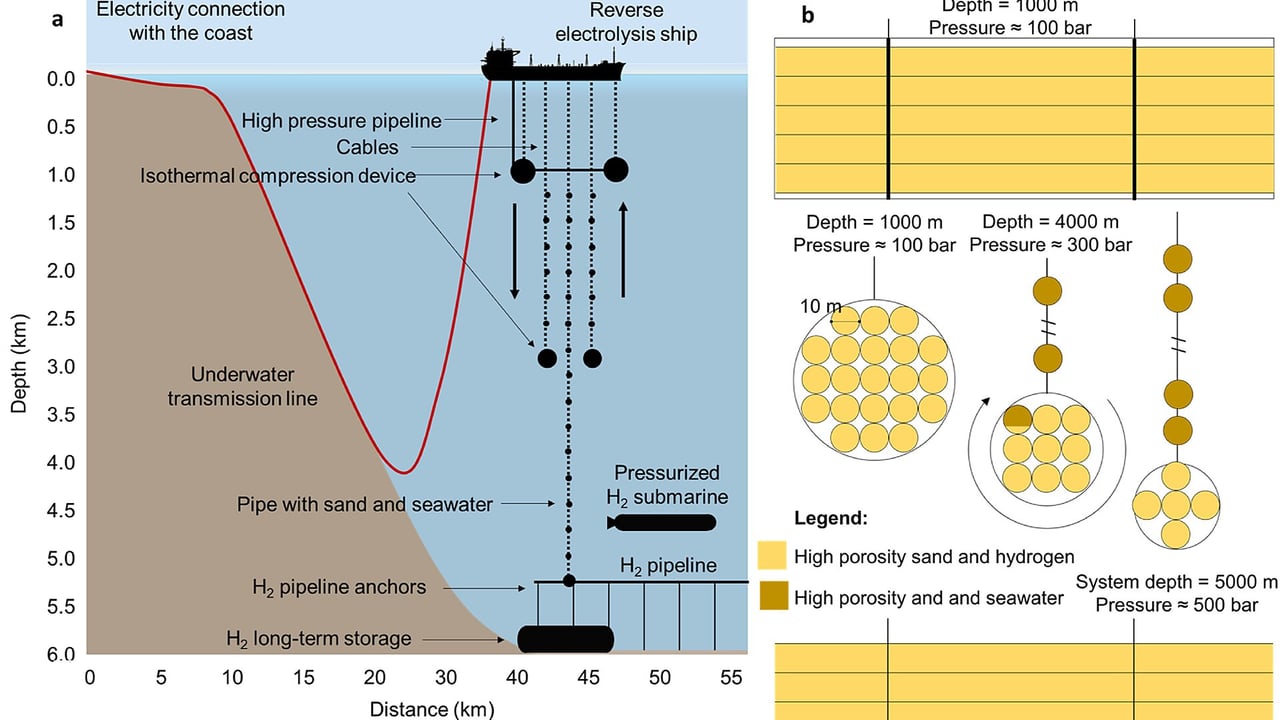
Authors of the study: Julian David Hunt, Andreas Nascimento, Behnam Zakeri, Paulo Sérgio Franco Barbosa via Wikimedia Commons, CC BY 4.0
The Brief
China has commissioned its first salt cavern hydrogen storage facility in Pingdingshan, Henan Province, achieving an operational storage scale of 1.5 million standard cubic meters. According to an account in People's Daily authored by an engineer at the Institute of Rock and Soil Mechanics under the Chinese Academy of Sciences, the project overcomes severe geological leakage risks associated with China's interlayered salt rock formations. Equipped with domestically developed hydrogen-resistant casings and an integrated monitoring system, the facility is designed to buffer renewable electricity and supply industrial green hydrogen.
Why it matters
Large-scale hydrogen storage remains a critical missing link in scaling up green hydrogen supply chains globally. While conventional surface tanks are limited in capacity and expensive to maintain, underground salt caverns offer massive volume, low operational costs, and high safety. Demonstrating successful hydrogen containment in layered salt geology bridges the gap between intermittent renewable energy generation and industrial decarbonization needs in sectors like metallurgy and chemical manufacturing.
China context
Unlike the thick, monolithic salt domes found in Western countries, domestic salt deposits in China consist predominantly of layered salt rock interleaved with mudstone. This interlayered structure presents higher gas permeability and leakage risks, particularly for tiny, highly diffusive hydrogen molecules. By developing tailored site selection methods, hydrogen-resistant alloys, and integrated monitoring systems, Chinese researchers are transforming complex domestic salt deposits into strategic energy storage assets.
Editor's View
EDITOR'S VIEW — Analysis and inference, not factual reporting.
The successful deployment of the Pingdingshan salt cavern marks a key technical transition from conventional natural gas storage to hydrogen containment under challenging geological conditions. However, the true test lies in long-term operational durability. Repeated injection and extraction cycles create thermodynamic and mechanical stress on interlayered mudstone, demanding sustained monitoring of micro-seismic activity and gas-water interfaces. If standardized, this technical approach could unlock substantial subterranean storage capacity across China's industrial heartlands.
What to watch
- Continuous safety and pressure monitoring data from the Pingdingshan cavern during seasonal injection and discharge cycles.
- Progress toward standardizing technical specifications for expanding salt cavern hydrogen storage across other Chinese mining regions.
- Integration of the facility with local industrial demand, including hydrogen refueling networks and chemical complexes in Henan.
Key Takeaways
- 1China's first salt cavern hydrogen storage facility was built in Pingdingshan, Henan, holding 1.5 million standard cubic meters of hydrogen.
- 2The facility addresses complex geological conditions characterized by layered salt rock and permeable mudstone interlayers.
- 3Researchers developed hydrogen-resistant casing materials and 100% domestic core equipment to prevent leakage and material degradation.
- 4An integrated monitoring system tracks hydrogen concentration, gas-water interfaces, and cavern stability in real time.
- 5The site aims to balance renewable power grids and supply green hydrogen to chemical, metallurgical, and transport sectors.
In an effort to overcome long-standing bottlenecks in green energy storage, researchers in China have established the country's first subterranean salt cavern hydrogen storage facility in Pingdingshan, Henan Province. According to a report published in People's Daily by an engineer at the Chinese Academy of Sciences' Institute of Rock and Soil Mechanics, the facility is currently operating safely with a storage volume of 1.5 million standard cubic meters of hydrogen.
Salt cavern storage—created in underground voids left by salt mining—offers large capacity, strong sealing, and low unit costs compared to traditional surface pressure tanks. While similar subterranean sites in China have stored over 1 billion cubic meters of natural gas, storing hydrogen presents distinct engineering hurdles. Hydrogen molecules are significantly smaller and more diffusive than methane, increasing leakage risks. Furthermore, hydrogen induces corrosion and embrittlement in standard metal and concrete materials.
Geological conditions in China added further complexity. Unlike the uniform salt domes common in Western Europe and North America, Chinese salt deposits are predominantly layered, featuring alternating strata of salt rock and highly permeable mudstone. To address this, researchers extracted rock cores from depths of approximately 1,300 meters to conduct hundreds of hydrogen seepage experiments. This testing established new criteria for site selection, cavern depth, and containment boundaries.
The project team also deployed domestically produced casing materials engineered to resist hydrogen corrosion and embrittlement. To ensure operational safety, an integrated monitoring system tracks real-time parameters across the surface, wellbore, and cavern, including hydrogen concentrations, gas-water interface levels, and subterranean vibrations.
The Pingdingshan facility is designed to absorb surplus renewable electricity by converting it into hydrogen, helping to smooth power grid fluctuations. The stored green hydrogen can subsequently serve as raw material for chemical and metallurgical industries or supply regional hydrogen refueling infrastructure. Researchers plan to further standardize the construction and operational model to replicate salt cavern storage across other domestic salt mining districts.
Sources
- 建设安全可靠的“地下氢能仓库”(创新故事) --经济·科技--人民网 — People's Daily · 8/2/2026